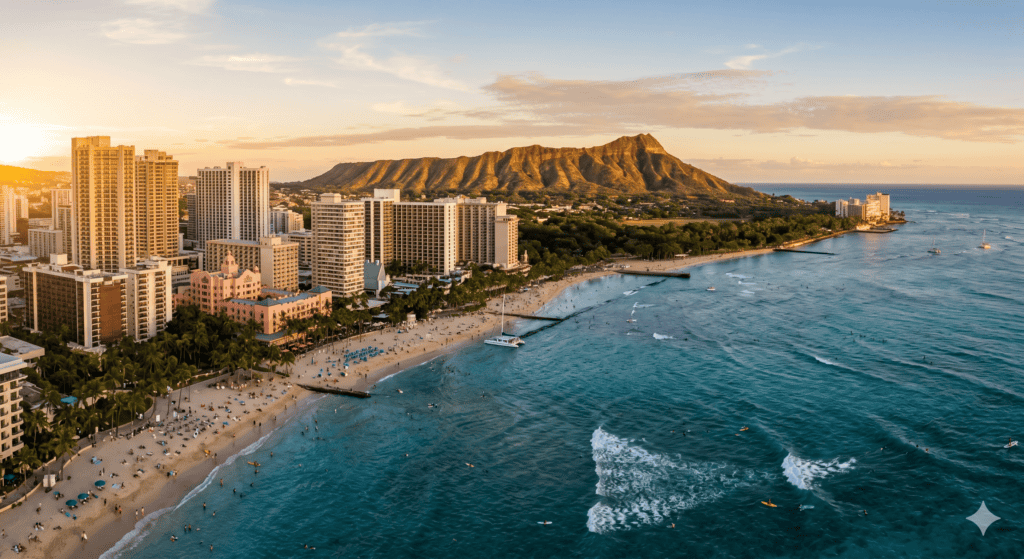
Everyone comes to Waikiki for the beach. Almost nobody comes for the history of Waikiki, which is a little bit of a shame, because the sand under your beach chair has a wilder backstory than most of the resorts lining it. This narrow strip of shoreline was once one of the most productive food-growing systems in the Pacific, then a royal battleground, then Hawaii’s first tourist boom, and only much later did it become the postcard beach vacation you’re picturing right now. Here’s the version of Waikiki’s history that actually explains why the place looks and feels the way it does.
What “Waikiki” Actually Means
Waikīkī translates to “spouting fresh water,” and that’s not a poetic stretch — it’s geography. Streams and underground springs once fed a network of wetlands just behind the shoreline, keeping the land lush, wet, and unusually fertile for a beach town. If your only mental image of Waikiki is high-rises and mai tais, it’s worth sitting with that for a second: this was a freshwater place before it was ever a saltwater one.
The Early History of Waikiki: Fishponds and Taro Fields Before the Hotels
For centuries before any hotel broke ground, Waikiki functioned as a serious food-production system. Hawaiian engineers built extensive loko iʻa, or fishponds, and irrigated taro fields fed by runoff from the Mānoa, Pālolo, and Makiki valleys. It wasn’t a handful of scattered ponds, either — historical accounts describe a dense, interconnected network that fed a large population, managed with a level of hydrological planning that modern sustainability consultants would probably charge a fortune for today.
Waikiki’s calmer waters also made it a natural home for heʻe nalu, or wave-sliding — early Hawaiian surfing. Aliʻi and commoners alike rode these breaks long before anyone thought to sell a surf lesson. If you want to try the modern version, most first-time visitors book their first session right along this same stretch of coast, which is worth planning around if it’s your first Waikiki trip.
The 1795 Battle That Made Waikiki a Royal Capital
In 1795, King Kamehameha I landed at Waikiki with a fleet historians estimate carried somewhere between 10,000 and 12,000 warriors, launching the campaign to unify Oʻahu under his rule. The fighting climaxed at the Battle of Nuʻuanu, where Kamehameha’s forces pushed their opponents up the valley and, in the battle’s brutal final stretch, over the cliffs of the Pali — the same lookout where visitors now stop for photos and get hit with that famous wind.
Waikiki became Kamehameha’s base in the years that followed, effectively serving as the seat of the young Hawaiian Kingdom while he consolidated power across the islands. That lasted until 1809, when Kamehameha shifted his residence to Honolulu Harbor to keep a closer eye on the growing sandalwood trade — a very practical reason to trade a beachfront address for a working harbor.
Sans Souci, the Moana, and the Birth of Waikiki Tourism
Waikiki’s tourism story has a clear starting gun: 1893, when Greek-American entrepreneur George Lycurgus leased a guest house on the beach and renamed it Sans Souci, French for “without worries.” That same year, author Robert Louis Stevenson checked in for five weeks and later wrote that he’d recommend the place to anyone who wanted “lovely scenery, quiet, pure air, clear sea water, good food, and heavenly sunsets.” Not bad advertising copy for a guy who wasn’t being paid for it.
The Moana Hotel, now the Moana Surfrider, opened on March 11, 1901, as Waikiki’s first proper hotel, and it wasn’t shy about showing off: it was the first hotel in the territory with private bathrooms, in-room telephones, and an electric elevator. The Royal Hawaiian followed on February 1, 1927, a four-million-dollar, Moorish-pink showpiece built by the Matson Navigation Company that opened with a black-tie gala for over 1,200 guests. Between the two of them, they set the template for Waikiki resort life that’s still recognizable today. Add Elvis Presley’s 1961 film Blue Hawaii into the mix a few decades later, and you’ve got the postcard image most people still carry around in their heads.
The Man-Made History of Waikiki Beach
Here’s the fact that tends to get the best reaction: Waikiki Beach, as you know it, is largely engineered.
The turning point was the Ala Wai Canal, built between 1921 and 1928 after territorial officials — citing mosquitoes and public health concerns — decided to drain roughly 625 acres of wetland and redirect stream runoff away from the shoreline. It worked exactly as intended: draining the taro fields and fishponds cleared the way for the hotel district we know now, but it also cut off the natural sand supply that used to replenish the beach.
So officials imported some. Records from the 1920s and 1930s show ships and railcars hauling sand in from Manhattan Beach, California, until that practice stopped in the 1970s; more recent replenishment has come from sources around Oʻahu and Molokai instead. Since 1929, an estimated 616,500 cubic yards of sand have been added to keep the beach between Fort DeRussy and Kūhiō Beach looking the way tourists expect. Engineers also built groins — including the Royal Hawaiian groin in 1927 — to slow the sand from drifting away, though those came with a side effect: they starved the beach further down the coast near Halekulani of new sand, which is part of why erosion is still a live issue today.
Waikiki by the Numbers — and Where to Catch the Free Hula Show
Waikiki is small, but the traffic through it is enormous. A 2002 state economic report put daily visitor occupancy at roughly 72,000 people — more than the population of many small American cities, packed into a couple of square miles — and the district has remained one of the state’s largest economic engines ever since, contributing billions in visitor spending annually. If you’re weighing where to spend your limited vacation days, it’s worth comparing what else is worth doing nearby before you commit your whole trip to the beach chair.
For a low-key evening that connects you to all of this history, head to the Kūhiō Beach Hula Mound near the Duke Kahanamoku statue for the free Kuhio Beach Hula Show. It runs Saturdays and the first and third Tuesday of each month, typically 6:30 to 7:30 p.m., weather and parade schedules permitting. Bring a mat, arrive early for a spot on the grass, and you’ll get live Hawaiian music and hula in the same stretch of sand where all of this history actually happened. Pair it with one of the better luaus near Waikiki if you want a fuller cultural evening, and check ways to save money around Waikiki, since a lot of the best cultural experiences here, including this one, are free.
Frequently Asked Questions
What does “Waikiki” mean?
Waikiki means “spouting fresh water,” a reference to the springs and streams that once fed the wetlands behind the beach before development drained the area in the early twentieth century.
Is Waikiki Beach really man-made?
Much of it, yes. The sand has been imported, trucked in, and replenished repeatedly since the 1920s, and structures like the Royal Hawaiian groin were built specifically to hold sand in place against erosion.
Was Waikiki ever the capital of Hawaii?
Effectively, yes. After the 1795 Battle of Nuʻuanu, Kamehameha I based himself at Waikiki as he consolidated the islands under his rule, until he relocated to Honolulu Harbor in 1809.
When did Waikiki become a tourist destination?
Tourism traces back to 1893, when the Sans Souci guest house opened and hosted author Robert Louis Stevenson. The Moana Hotel followed in 1901 as Waikiki’s first purpose-built resort.
Where can I see the free hula show in Waikiki?
The Kuhio Beach Hula Show runs Saturdays and the first and third Tuesday of each month, roughly 6:30 to 7:30 p.m., at the Kūhiō Beach Hula Mound near the Duke Kahanamoku statue.
Why was sand imported to Waikiki from California?
Draining the wetlands for the Ala Wai Canal cut off Waikiki’s natural sand supply, so officials shipped in sand from Manhattan Beach, California, during the 1920s and 1930s to keep the shoreline intact.
None of this makes Waikiki less of a beach vacation — it just makes it a more interesting one. Next time you’re walking Kalākaua Avenue past the resorts and the shave ice stands, you’re standing on top of a working fishpond, a battlefield, a drained wetland, and a hundred years of imported sand, all doing a very convincing impression of a simple beach.