
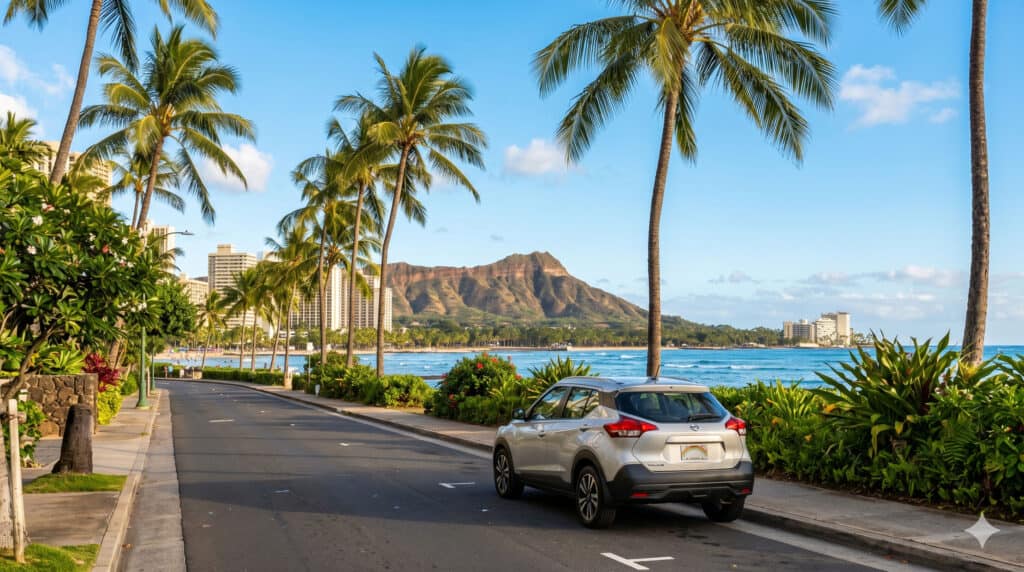
but not always necessary for a great trip.
If Waikiki is your home base on Oʻahu, you probably don’t need a rental car — and a surprising number of visitors are genuinely happier without one. Waikiki is compact, walkable, and loaded with beaches, restaurants, and things to do that are all within easy reach on foot. Pair that with rideshares, TheBus, Biki bikes, and the Waikiki Trolley, and you’ve got solid transportation for most of what a vacation here actually involves.
That said, renting a car unlocks a completely different version of Oʻahu — one with early-morning coastal drives, spontaneous roadside stops, and the freedom to leave Waikiki whenever you feel like it. The question isn’t really “car vs. no car.” It’s about what your specific trip looks like and how many island adventures you have on the list.
Here’s how to think through it.
Skip the rental car if your trip looks like this
Most visitors staying in Waikiki don’t need a car for the majority of their trip. The neighborhood is only a few square miles, and nearly everything tourist-friendly is either walkable or a short rideshare away. You’ll probably be fine skipping the car if:
- You’re spending most of your time at the beach, shopping, and dining in Waikiki
- You have a shorter trip (3–5 days) with only one or two day trips planned
- You’d rather not deal with nightly parking fees at your hotel
- You’re traveling solo or as a couple without a lot of gear
- Your main excursions are tour-friendly — Pearl Harbor, Hanauma Bay, and Kualoa Ranch all have excellent guided tour options that handle transportation for you
The honest truth: plenty of people do a full week in Waikiki without a car and never feel like they missed anything. Waikiki is specifically designed to be enjoyed without one.
You’ll want a rental car if your itinerary goes beyond Waikiki
Here’s where the math flips. Once your itinerary starts filling up with places that are 30–60 minutes from Waikiki, a car stops being a burden and starts being a genuine asset. Renting makes a lot of sense if you’re planning to:
- Hit the North Shore — Haleʻiwa, Laniakea Beach (sea turtles!), Shark’s Cove, and Sunset Beach are best explored at your own pace, with room to pull over whenever something looks interesting
- Explore the Windward Coast — Kailua and Lanikai are beautiful, and getting there on your own schedule beats waiting on a bus timetable
- Drive the Southeast Shore — Halona Blowhole, Sandy Beach, and Makapuʻu Lookout are classic pull-over destinations where the fun is in the spontaneity
- Visit multiple stops in a single day — if your plan involves three or more destinations, a car turns that into a comfortable day trip; without one, it becomes a logistical puzzle
- Travel with kids and beach gear — bags, strollers, coolers, and sand toys are a much easier conversation in a rental than on TheBus
If several of those sound like your trip, the best day trips from Waikiki is a useful guide for figuring out which excursions genuinely benefit from having a car versus which ones work fine with a tour or rideshare.
Getting around Waikiki without a rental car
If you decide to skip the car for most or all of your trip, you have more options than you might expect.
Walk — seriously, it’s the best option inside Waikiki
Waikiki is flat, pleasantly shaded along stretches of Kalākaua Avenue, and genuinely enjoyable on foot. Most hotels put you within a few blocks of the beach, International Market Place, Royal Hawaiian Center, and a few dozen restaurant options. The only time walking becomes a stretch is when you keep going toward Diamond Head — which is a great idea, but calls for actual shoes rather than flip-flops.
TheBus + HOLO card
Honolulu’s public transit system is one of the most visitor-friendly in any U.S. city. Pay cash and the adult single fare is $3.25 as of July 2026; tap a HOLO card instead and it’s still $3.00, with free transfers in a 2.5-hour window and a $7.50 daily cap — once you hit that cap, the rest of the day’s rides are free. Multi-day passes (3-day and 7-day) are also available if you’re riding often. TheBus reaches most major Oʻahu destinations, including Hanauma Bay, Ala Moana Center, and Pearl Harbor — just budget extra time, since it’s slower than driving yourself.
Biki bike share
Biki is a great fit for flat-terrain cruising — the Ala Wai Canal path, Kapiʻolani Park, and the run toward Ala Moana are all pleasant on two wheels. Visitor subscription options include the Voyager pass (unlimited 45-minute rides, $30/month) and the Commuter pass (unlimited 30-minute rides, $25/month). It’s best for people staying near the coast who want a breezy, low-effort way to cover ground without waiting on a bus or paying surge pricing.
Uber and Lyft
Rideshares are plentiful in Waikiki and are often the right call for dinner reservations, quick hops across the neighborhood, or reaching spots that don’t have great bus access. If you’re in a group of three or four, split the cost — a short Waikiki rideshare becomes pretty reasonable when divided.
Waikiki Trolley
The Waikiki Trolley runs several color-coded routes covering the neighborhood’s major stops, including a dedicated Pink Line to Ala Moana Center. It’s low-effort and relaxed — the open-air cars make it feel more like part of the vacation than just a ride across town. Good option if you’re not in a hurry and want a bit of atmosphere built into the commute.
For everything you can do once you’re settled in Waikiki and car-free, the 15 best things to do in Waikiki covers every activity that’s walkable or a short rideshare away.
The real cost of renting a car in Waikiki
Rental cars look affordable at the search stage. By the time you’ve added everything up, the math often tells a different story. Here’s what tends to catch people off guard:
- Hotel parking: Many Waikiki hotels charge $40–$60+ per night for self-parking, with valet running higher. On a week-long stay, that’s $280–$420 in parking before you’ve driven anywhere worth mentioning.
- Taxes and surcharges: Hawaii adds a combination of state, county, and tourism-related fees to car rentals. What you see quoted and what you pay at the counter can differ noticeably — build in a buffer.
- Collision Damage Waiver (CDW): Rental companies offer their own coverage at $15–$30/day or more. Whether you need it depends on your credit card coverage and personal auto policy — more on that in the next section.
- Fuel: Most rental agreements require a full tank at return. Gas prices in Hawaii tend to run higher than the mainland, so factor that in for any full-day excursion.
- Traffic and time: Honolulu traffic is real. A 20-minute drive on the map can turn into 45 minutes during peak commute hours, especially along the H-1 corridor and around Waikiki’s one-way street grid.
None of this means you shouldn’t rent a car. It just means going in with a clear picture of what the total cost actually looks like, not just the base rate.
Your credit card might already cover rental car insurance
This is one of the most underused travel benefits out there, and it can save you a meaningful amount of money. Many travel credit cards — including most Visa Signature, Mastercard World Elite, and premium Amex cards — include some form of rental car coverage when you pay for the rental with that card and decline the rental company’s CDW at the counter.
The details matter, though. Some cards offer primary coverage (they pay first, before your personal auto insurance is involved). Others offer secondary coverage (they cover what your own insurance doesn’t). Coverage limits, vehicle class restrictions, and international vs. domestic rules all vary by card. Before you make a decision at the counter, spend 10 minutes on the phone with your card issuer to understand exactly what you have. It’s one of the easiest ways to cut $100–$200 from the cost of a week-long rental.
Also worth a quick check: your personal auto insurance policy may extend to rental cars. Coverage types and limits differ by policy and state, so a short call to your insurer before your trip is always worthwhile — especially if you’re carrying a higher-deductible plan.
The smartest approach: rent a car only on island adventure days
For most Waikiki visitors, this is the strategy that makes the most sense. Instead of renting for the entire trip and paying hotel parking every night while the car sits in a garage, rent only on the specific days you’re actually leaving Waikiki.
Here’s how that might look on a 6-day trip:
- Days 1–2: Settle in, beach time, dinner in Waikiki — no car needed
- Day 3: Rent a car for the North Shore (Haleʻiwa, Laniakea turtles, Shark’s Cove, food trucks)
- Day 4: Return the car, back to Waikiki on foot and rideshare
- Day 5: Rent again for the Windward Coast (Kailua Beach, Lanikai, Pali Highway lookout on the way back)
- Day 6: Final beach morning, shopping, departure prep — no car needed
This sidesteps the nightly parking fees entirely and gives you car flexibility on the days that actually call for it. Most Waikiki-area rental pickups are straightforward — grab the car in the morning, return it by evening. The 5-day Waikiki itinerary builds a similar day-by-day framework if you want a ready-made structure to adapt from.
Getting from Honolulu Airport to Waikiki without a rental car
If you’ve decided to skip the car for arrival day, you have solid options. TheBus “W Line” runs directly between HNL and Waikiki — baggage rules apply, so it works best if you’re packing light. Taxis offer published flat-rate options to Waikiki, which are useful for avoiding meter anxiety in traffic. Rideshares via Uber or Lyft are widely available from the airport’s designated pickup zone. For a full comparison of every arrival option with current pricing, the Honolulu Airport to Waikiki transportation guide covers it all in one place.
Rental car FAQ for Waikiki visitors
Is it cheaper to use Uber and Lyft or rent a car in Waikiki?
For getting around within Waikiki, rideshares are almost always cheaper — you’re not paying parking, insurance, or fuel. A rental becomes cost-competitive when you’re taking multiple all-day island excursions. Five or six Uber trips to different corners of Oʻahu adds up fast; a single-day rental for a North Shore run often comes out ahead, especially for a group splitting the cost.
How much does hotel parking cost in Waikiki?
It varies by property, but many Waikiki hotels charge $40–$60+ per night for self-parking, with valet options running higher. A few properties have arrangements with nearby garages that come out cheaper — check your specific hotel’s parking page before assuming. Factor parking into your total rental car cost calculation before booking. It’s often the number that tips the scales against renting for the full trip.
Can TheBus get me to major Oʻahu attractions?
Yes — TheBus reaches most major attractions, including Hanauma Bay (when open), Pearl Harbor, Ala Moana Center, and many windward-side destinations. The trade-off is time. Trips that take 20 minutes by car can take 90 minutes by bus on a multi-stop day. TheBus works best for single-destination outings; for packed day-trip itineraries with several stops, it’s typically the less practical choice.
What’s the minimum age to rent a car in Hawaii?
Most rental companies in Hawaii require drivers to be at least 21 years old. Drivers under 25 typically pay a young-renter surcharge — often $25–$45 per day depending on the brand — which can significantly change the economics of a rental. Some companies also restrict under-25 drivers to specific vehicle classes. Check the age policy directly with your chosen rental company before booking, as it varies by brand.
Do I need a car to visit Diamond Head?
No — Diamond Head is reachable by rideshare and isn’t far from the eastern end of Waikiki. Non-residents need advance reservations for both entry and parking, so if you’re driving yourself, book both ahead. If you rideshare in, you’ll need only the entry reservation (no parking reservation required). See the full Diamond Head guide for current fees, hours, and booking details.
What size car should I rent on Oʻahu?
For most Waikiki visitors, a compact or mid-size car is the right call. Parking structures in Waikiki can be tight, and something maneuverable saves headaches. If you’re heading to beaches with significant gear — surfboards, a stroller, a full cooler — an SUV might be worth it. Skip the luxury or premium upgrades unless you have a specific reason; the roads don’t require them, and the savings are better spent on activities or food.
Bottom line
If your Waikiki trip is beach-forward with a few guided tours mixed in, you probably don’t need a rental car at all. Waikiki is easy to navigate on foot and by rideshare, and skipping the car means skipping nightly parking fees, insurance decisions, and traffic headaches.
If your itinerary is island-adventure-heavy — North Shore days, windward coast exploring, scenic drives with a lot of spontaneous stops — a car makes the trip noticeably better. The smartest approach for most visitors lands in the middle: rent a car for one or two specific days, not the entire week.
Either way, you’re in Hawaiʻi — which means the trip is already working. For help mapping out the rest of it, the Waikiki packing guide and the top day trips from Waikiki are good next reads.