
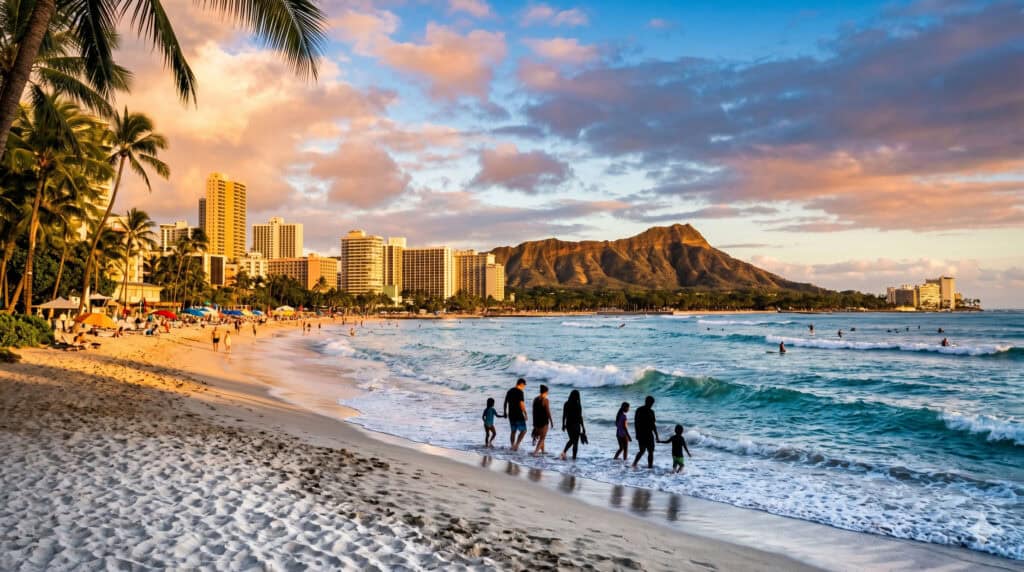
There’s a moment most first-timers describe the same way. You step off the plane at Daniel K. Inouye International Airport, and the air hits you — warm, soft, carrying just a trace of plumeria. Twenty minutes later, you round the corner of Kalākaua Avenue and the Pacific appears: impossibly blue, Diamond Head framing the horizon. That’s Waikiki. And yes, it really does look like that.
For first-time visitors, the destination delivers. But the planning — how long to stay, where to sleep, what to book before you arrive, what things actually cost — that’s where people struggle. This guide covers all of it: trip length, timing, getting around, where to stay, what to do, the best day trips from your hotel, and the booking mistakes that can quietly ruin a trip if you don’t see them coming.
How Long Should You Stay in Waikiki on Your First Visit?
The most common first-timer mistake is not staying long enough. Waikiki rewards you for slowing down — and once you’re on island time, you burn through days faster than you’d expect in the best possible way.
- 3–5 nights: A solid sampler. You can cover the beach, Diamond Head, Pearl Harbor, and one evening activity like a luau or sunset cruise. It’ll feel a little packed, but you’ll leave satisfied.
- 7 nights: The sweet spot for most first-timers. You get beach days, two or three day trips, a real cultural experience, and enough downtime to not need a vacation when you get home.
- 10 nights: The “do it right” option. You’ll hit every highlight, take a breath, and still have a day to discover something spontaneous. Highly recommended if your schedule allows it.
- 14 nights: For slow travelers, honeymooners, or anyone who wants to explore beyond Oʻahu. Two weeks gives you room to add a neighbor island or just enjoy Waikiki at a genuinely unhurried pace.
If you’re torn between 7 and 10 nights, go with 10. Nobody has ever come home from Waikiki wishing they’d cut the trip shorter. For a day-by-day blueprint, our 5-day Waikiki itinerary and 10-day Waikiki itinerary lay out each day in detail so you’re not guessing when you arrive.
Best Time to Visit Waikiki for First-Timers
Honest answer: there’s no bad month to visit. Hawaii doesn’t have four dramatic seasons — it’s more like warm and warmer, with shifts in rainfall, surf, and crowd levels. But some windows are noticeably better for first-timers trying to balance cost, weather, and elbow room on the beach.
Best value windows: April–May and September–October. These shoulder seasons tend to deliver lower hotel rates, smaller crowds, and sunshine in equal measure. If you have any schedule flexibility at all, this is the range to target. You’ll get the experience you came for without fighting for beach space or paying peak prices.
Summer (June–August) is peak family season — lively, warm, and more expensive. Winter (December–March) brings whale watching season (humpbacks migrate through Hawaiian waters between December and March, and most reputable boat operators offer a free reschedule if none appear), holiday atmosphere, and slightly more passing showers. Waikiki rain usually arrives fast and leaves even faster, often with a rainbow attached. Year-round temperatures stay in the low-to-mid 80s°F.
Getting to Waikiki and Getting Around the Neighborhood
Most visitors fly into Daniel K. Inouye International Airport (HNL), about 8 miles from Waikiki — anywhere from 20 to 45 minutes depending on traffic. Your main options from the airport:
- Rideshare (Uber/Lyft): Most popular for convenience. Pickup zones have been updated — follow current in-app directions and ground-level signage at baggage claim. Compare both apps before committing; pricing shifts with demand.
- Taxi: Reliable, especially with a lot of luggage. AMPCO Express dispatchers in yellow shirts manage the taxi queue at the center median near baggage claim.
- Shared shuttle: Budget-friendlier, but slower — you’ll make multiple hotel stops before reaching yours.
- TheBus (W Line / Route 20): The most affordable option, though less practical with heavy luggage after a long flight.
For full details on current pricing and pickup logistics, see our guide on getting from Honolulu Airport to Waikiki.
Once you’re in Waikiki, you may not need a car at all. The neighborhood runs about a mile and a half along Kalākaua Avenue — walkable end to end. For ranging further: TheBus covers much of Oʻahu for $3 a ride, Biki bike share handles short hops, rideshare is your reliable backup, and the Waikiki Trolley offers a hop-on, hop-off option with 30+ stops starting around $30 for a day pass. Rent a car only if you want to drive yourself to the North Shore, remote beaches, or sunrise hikes on your own schedule — and skip the hotel parking ($35–45/night) on evenings you don’t need it.
Where to Stay in Waikiki on Your First Visit
Location matters more than most visitors realize. The difference between a hotel one block from the beach and one five blocks back shapes your entire daily rhythm. Here’s a quick breakdown by budget — all rate ranges are approximate and change seasonally, so verify directly with hotels.
Budget (under $200/night): The Royal Grove Hotel is Waikiki’s most charming value option — a small, family-run property with vintage character, a few blocks from the sand. The Sheraton Princess Kaiulani offers Marriott-brand reliability across the street from the beach, typically starting around $180–220.
Mid-range ($200–$400/night): The Outrigger Waikiki Beach Resort sits directly on the beach and hosts Duke’s Waikiki restaurant plus complimentary daily cultural activities — hard to beat for location and value. The Hyatt Regency offers prime beachfront real estate with four restaurants and a full spa (note: this is the busiest stretch of beach).
Luxury ($400+/night): The Royal Hawaiian — “the Pink Palace” — is a 1927 Spanish-Moorish icon with its own beach zone, a legendary Mai Tai Bar, and cultural programming that earns its reputation. Halekulani is the finest hotel on the beach: impeccable service, no resort fees, and home to La Mer and House Without a Key. The Moana Surfrider delivers that “we’re really here” feeling that first-timers remember for decades.
One thing to factor into your hotel budget before booking: resort fees and Hawaii’s stacked tax structure add roughly 18–19% on top of your nightly rate on Oʻahu in 2026. The rate you see online is rarely what you pay at checkout.
The Experiences Every First-Timer Should Have
A few activities require advance reservations and fill up fast — those are flagged clearly below. Everything else can be arranged with a week or two of lead time, or right from your hotel concierge once you arrive.
Learn to Surf — The Right Way
Waikiki’s gentle south shore breaks are the most beginner-friendly surf in Hawaii — warm water, soft waves, experienced instructors who have coaxed thousands of first-timers to their feet. A two-hour group lesson runs $60–100 per person; no experience needed. Book for 8–9am: the water is glassier, the crowd is thinner, and the light on the water is something worth seeing.
Hike Diamond Head Before the Heat Sets In
The hike to the rim of the volcanic crater is 0.8 miles one way, gaining 560 feet through a tunnel, up switchbacks, and past 99 final steps to a lookout with 360-degree views of Waikiki, the Pacific, and the island. The round trip takes 60–90 minutes and earns every step. Non-residents must reserve entry in advance at gostateparks.hawaii.gov — reservations open 30 days ahead and early slots sell out within hours of release. Verify current fees and policies before visiting. Skip the car: TheBus Route 23 stops right at the entrance.
Catch the Free Hula Show on the Beach
The Kuhio Beach Hula Show at the Kuhio Beach Hula Mound — near the Duke Kahanamoku Statue — runs Tuesday, Thursday, and Saturday evenings. Local hālau perform traditional and contemporary hula against a backdrop of torchlight and the ocean. Watching from the sand costs nothing. It quietly becomes the memory of the trip for many first-time visitors — especially if you discover it by accident. Build it in on day one, not day seven.
Take a Sunset Catamaran Cruise
Multiple operators depart from Kewalo Basin for 90-minute cocktail sails to dinner cruises with live Hawaiian music. Between December and March, these same boats double as whale watching vessels. There are few better ways to end a Waikiki day than watching the sun drop behind the Waianae Mountains from a catamaran deck.
Snorkel Hawaii’s Reef
The water off Waikiki is warm, clear, and alive. Half-day snorkel cruises anchor at sites away from heavy in-shore traffic and give participants 60–90 minutes in the water. On a good day you’ll share the reef with Hawaiian green sea turtles, tropical fish in colors that feel impossible, and the occasional spotted eagle ray. These tours run $75–100 per person and represent some of the best value-per-experience in Waikiki.
Free Live Music — Two Spots Worth Knowing
Kani Ka Pila Grille at the Outrigger Reef hosts local Hawaiian musicians nightly from 6–9pm — traditional and contemporary slack-key guitar and ukulele. On Sunday afternoons, Duke’s Waikiki Barefoot Bar hosts Henry Kapono from 4–6pm, a beloved weekly ritual among locals and returning visitors. Arrive by 3:30pm for a good seat. Both are free to enjoy.
For a comprehensive list of activities with timing and cost details, see our guide to the best things to do in Waikiki. And if the weather briefly turns on you — it happens — our rainy day activities in Waikiki guide has you covered.
Top Day Trips from Your Waikiki Base
Waikiki is an excellent base camp for the broader island. Here are the three day trips that belong on most first-timer itineraries — each requires advance planning, so don’t leave them until you arrive.
Pearl Harbor (≈20 minutes west): One of the most-visited historic sites in the United States, and for first-timers on Oʻahu, a near-essential experience. Entry to the grounds and visitor center is free. The emotional core is the USS Arizona Memorial — a white structure built directly over the submerged wreck. Advance reservations for the Memorial boat tour are temporarily paused as of September 2026** while the National Park Service completes preservation work — check nps.gov/perl for the latest status before you go. In the meantime, access is running first-come, first-served, with a small batch of next-day tickets released daily. No bags are allowed at the memorial.
North Shore (≈45 minutes by car): Waikiki’s photographic opposite — open coastline, food trucks, and in winter, waves that reach 30 feet when the world’s best surfers compete. In summer, the same breaks calm into excellent snorkeling. The town of Haleʻiwa anchors the experience with its wooden storefronts and shave ice stands. You need a rental car; allow a full day.
Hanauma Bay (≈15 minutes east): A protected marine sanctuary inside a collapsed volcanic cone. Fish here are so comfortable with visitors they swim alongside you. Hanauma Bay requires advance reservations, is closed Mondays and Tuesdays, and limits daily visitors — set an alarm for when the booking window opens. Our dedicated Hanauma Bay guide covers the full reservation system, fees, and what to bring. For all 20 options beyond these three, see our complete day trips from Waikiki guide.
What Your First Waikiki Trip Will Cost
Waikiki has a reputation for being expensive — and it can be. But your total cost depends more on the choices you make than on the destination itself. A rough daily range for two people, not counting flights or hotel:
- Budget trip: $250–$400/day (value hotel, mostly casual dining, free and low-cost activities)
- Mid-range trip: $450–$700/day (mid-tier hotel, a mix of dining styles, one or two paid activities per day)
- Splurge trip: $800–$1,200+/day (beachfront resort, fine dining, premium tours)
On the food side, the smartest move is to mix one nicer sit-down meal per day with plate lunches, local spots, and grab-and-go options. Rainbow Drive-In is the classic for affordable plate-lunch energy. Musubi Cafe Iyasume is perfect for a quick, inexpensive bite between adventures. For a relaxed evening with solid local food and no fine-dining bill, Cuckoo Coconuts delivers. For a splurge dinner that’s worth every dollar, House Without a Key at Halekulani — sit under the century-old kiawe tree with a cocktail, watch a hula dancer perform against a Diamond Head sunset, and understand why people return for decades.
First-Timer Mistakes to Avoid
These are the moves that quietly cost people the most — time, money, and experience.
- Not booking Diamond Head, Pearl Harbor, and Hanauma Bay before you arrive. Non-residents are turned away at Diamond Head without a reservation. The USS Arizona Memorial fills up weeks out. Hanauma Bay reservations open two days ahead and sell out fast. Lock these in first.
- Renting a car for the whole trip. Waikiki is exceptionally walkable. Rent a car only for the day or two you plan to explore outside the neighborhood — and pick it up in Waikiki rather than at the airport to reduce taxes and fees.
- Going to the beach at noon. The best Waikiki beach experience happens in the morning (8–9am for widest sand and calmest water) or late afternoon (4–6pm for golden light and room to breathe). Midday is best spent in the shade.
- Missing the free evening shows. The free hula shows at Kuhio Beach, the nightly music at Kani Ka Pila Grille, and Henry Kapono’s Sunday sessions at Duke’s are experiences many visitors discover only on their last night. Build one into day one.
- Forgetting reef-safe sunscreen. Hawaii prohibits sunscreen containing oxybenzone or octinoxate. Most name-brand sunscreens contain one or both — check the label before you pack, or pick up a reef-safe option at any ABC Store in Waikiki.
- Over-scheduling. Most first-timers pack so tightly they spend half the trip rushing. Plan your must-dos, then protect the white space around them. A slow morning followed by a long afternoon at the beach is not wasted time — it’s the point.
For a complete rundown of what to bring and what to leave at home, our Waikiki packing list has the full breakdown.
Frequently Asked Questions About Your First Trip to Waikiki
Is Waikiki a good destination for first-time visitors to Hawaii?
Yes — arguably the best starting point in all of Hawaii. It’s walkable, packed with things to do at every budget, and perfectly positioned for day trips around Oʻahu. Pearl Harbor is 20 minutes west. Diamond Head is at the neighborhood’s eastern edge. The North Shore is 45 minutes by car. For a first visit, Waikiki gives you everything without requiring you to have everything figured out.
Do I need to rent a car in Waikiki?
Not for the first two or three days. Waikiki is walkable, rideshare covers the gaps, and TheBus reaches more of the island than most visitors expect. Renting a car makes sense when you want to explore the North Shore, remote beaches, or sunrise hikes on your own schedule — without tour group logistics. When you do rent, pick up from a Waikiki location rather than the airport to avoid higher taxes and fees.
How much spending money do I need per day in Waikiki?
For two people, plan on $250–$400/day for a value-focused experience, or $450–$700/day for a mid-range trip — not counting flights or hotel. The biggest daily levers are dining style and paid activities. Building in one nicer meal and mixing free experiences (beach, hula shows, Kalākaua Avenue walks) with one paid activity per day keeps costs manageable without feeling like you’re cutting corners.
What reservations do first-timers need to make before arriving in Waikiki?
Three things fill up fast: Diamond Head crater (non-resident entry, opens 30 days ahead at gostateparks.hawaii.gov), the USS Arizona Memorial boat tour at Pearl Harbor (normally opens 56 days ahead at recreation.gov, though advance reservations are paused as of September 2026 for preservation work — check nps.gov/perl for current status) and Hanauma Bay (opens two days in advance — set an alarm). Luaus at popular venues also sell out well ahead in peak season. Surf lessons and snorkel tours can typically be booked one to two weeks out.
What is the best time of year to visit Waikiki for the first time?
April–May and September–October offer the best combination of good weather, smaller crowds, and lower hotel rates. Summer (June–August) is busier and pricier but perfect for families. December–March brings whale watching season, a holiday atmosphere, and slightly more passing rain showers — though Waikiki rain rarely lasts long. The honest answer: the best month is the one that fits your budget and schedule.
What is the biggest mistake first-time visitors make in Waikiki?
Over-scheduling. Most first-timers pack their itineraries so tightly that they spend half the trip rushing rather than relaxing. Waikiki is at its best when you leave room to be surprised — to linger over a meal, stumble into a free hula show, or take a long swim because the water is too good to leave. Plan your must-dos, then protect the unscheduled time around them.
Waikiki is one of those rare places that delivers on the hype — and then surprises you with things the brochures didn’t mention. Book the big stuff early, leave room to breathe, and don’t overthink the rest. The island has a way of making things work out.