Here’s the sticker shock most first-time visitors don’t see coming: the rental car might run $55 a day, but parking it at a Waikiki hotel adds another $40 to $60 per night. Add taxes, gas, and the particular stress of navigating Kalākaua Avenue in bumper-to-bumper traffic, and a week of wheels can quietly top $750 before you’ve driven anywhere worth driving. Getting around Oahu without a car is genuinely easier than you’d expect — especially since the Skyline rail now connects directly to Daniel K. Inouye International Airport and the new W Line bus runs direct from HNL to Waikiki every ten minutes. This is your current, no-fluff guide to every realistic way to get around without a rental, updated with prices effective July 1, 2026 and a day-by-day itinerary you can actually follow.
Quick Answer: Do You Need a Car in Waikiki?
No — and for most visitors, skipping the rental saves $300 to $400 or more for the week. Waikiki is roughly two miles end-to-end and walkable in under an hour. TheBus covers the rest of the island affordably, the Waikiki Trolley handles the main tourist routes with live narration from local drivers, Biki bikes are perfect for short hops between beaches and restaurants, and rideshare fills whatever gaps are left for late nights and airport runs.
The one case where a rental actually makes sense: a dedicated North Shore day trip — Haleiwa, Waimea Bay, Sunset Beach, Dole Plantation. Pick up a one-day rental from a Waikiki desk rather than the airport (you skip at least one night of parking charges) and return it by dinner. That’s still far cheaper than a full week of wheels sitting in a hotel garage.
Every Way to Get Around Oahu Without a Car (2026 Prices)
Prices below reflect rates effective July 1, 2026, including the updated HOLO card pass structure.
| Option | Cost | Best For | Watch Out For |
|---|---|---|---|
| TheBus + Skyline (HOLO card) | $3 single ride / $7.50 day / $45 for 7 days | Island-wide travel, North Shore, airport runs | Luggage restricted to one medium bag + carry-on; slower than driving |
| Waikiki Trolley | Pink Line $6/day; Blue Line $35/$23 (adult/child); 1-Day All Lines $64 adult; 4-Day All Lines $76 adult | Diamond Head, Ala Moana, Iolani Palace, coastal sightseeing | Doesn’t serve the airport or Pearl Harbor; Blue Line runs every 40 minutes |
| Biki bike share | $4.50 per 30-min ride; $55 for 300 minutes (Free Spirit plan) | Beach-to-dinner hops, Ala Moana runs, flat areas | $5.25 overage per extra 30 min; bikes are heavy city cruisers, not speedsters |
| Uber / Lyft | $8–$20 within Waikiki; $25–$50 airport run | Late nights, group dinners, airport luggage hauls | Surge pricing during peak arrival waves (1.5–2x) |
| Airport shuttle | ~$18–$25 per person one-way | Solo travelers, heavy luggage, flat-rate predictability | Multiple hotel stops can add 20–40 minutes to arrival time |
| Rental car (1 day only) | ~$55–$100/day + $30–$60 parking | North Shore loop, windward coast, spontaneous island drives | Pick up from a Waikiki desk, not the airport, to avoid paying for a parking night |
The 7-Day Math: Car vs. No Car
Rough estimate for a couple spending a week in Waikiki:
- With a rental car: $55/day × 7 = $385 + $45/night parking × 7 = $315 + gas ~$50 = $750+
- Without a rental car: HOLO 7-day pass × 2 people = $90 + $4 card fees + one Trolley All-Lines day pass ~$128 + one-day North Shore rental ~$100 + gas $25 = ~$347
That’s roughly a $400 difference — money that covers a helicopter tour, a luau, or a week of seriously good dinners. Check our guide to saving money in Waikiki for more strategies along these lines.
TheBus and Skyline: The $45 Week Pass That Covers the Whole Island
Honolulu’s TheBus is consistently ranked among the best public transit systems in the country, and the Skyline rail — the first fully automated urban light rail in the U.S. — now runs from East Kapolei through downtown and out to the airport, with connections to everywhere else. Together, they’re the backbone of car-free travel on Oahu.
How to Pay: The HOLO Card
The HOLO card is a tap-and-go smart card that works on both TheBus and Skyline. Get one before your first ride — it makes every trip easier and saves you money versus paying cash.
- Card cost: $2 one-time fee
- Where to buy: Any ABC Store in Waikiki (including #66 at 2586 Kalakaua Ave), Skyline station vending machines, or the Transit Pass Office at Kalihi
- HOLO fares (adult, effective July 1, 2026): $3 per 2-Hour Pass (single ride), $7.50 daily cap, $45 for 7 days
- Cash fare: $3.25 per ride — drivers don’t make change, so carry exact
- Free transfers: Tap once and ride both TheBus and Skyline within a 2-hour window at no extra charge
- Kids under 6: One child rides free with a fare-paying adult
The smart move: pick up a pre-loaded HOLO card at an ABC Store. They often come with a day pass already loaded so you can tap and go the moment you arrive.
Fare Capping: Honolulu’s Best-Kept Visitor Secret
You don’t need to buy a day pass or weekly pass in advance. Just tap and ride. Once your HOLO card spending hits $7.50 in a single day, every ride after that is free for the rest of the day. Hit $45 over seven consecutive days and everything after that is free too. If you’re not sure how much you’ll ride, load $50 in value and let the card handle the math — it’s automatic.
The W Line: Airport to Waikiki for $3
Launched in October 2025, the W Line replaced the old Route 20 airport connection and runs every 10 minutes between the Lelepaua Skyline Station (ground level at the airport) and the main Waikiki hotel corridor — with stops in Downtown Honolulu, Kaka’ako, and Ala Moana along the way. Fare is $3. For light packers, it’s the cheapest airport option on the island and faster than the route it replaced.
The W Line runs until about 10:30 PM. After that, Route 42 covers late-night airport runs. Baggage rules apply: one medium suitcase plus one carry-on per person, nothing blocking the aisle. If you’ve got the family’s full luggage load, take a shuttle or rideshare instead. For a full breakdown of every airport-to-Waikiki option, see our complete guide to getting from Honolulu Airport to Waikiki.
Popular TheBus Routes for Visitors
- Route 2 or 13: Waikiki to Downtown Honolulu, Chinatown, and Bishop Museum
- Route 20: Waikiki to Pearl Harbor Visitor Center (~75 minutes)
- Route 22 (“The Beach Bus”): Waikiki to Hanauma Bay and Sea Life Park
- Route 60: Ala Moana to the North Shore (Haleiwa, Waimea, Sunset Beach) — about 2 hours each way, but the coastal views through the windward side are genuinely worth it
- W Line: Airport to Waikiki, about 45 minutes, every 10 minutes
Waikiki Trolley: Sightseeing Without the Navigation Stress
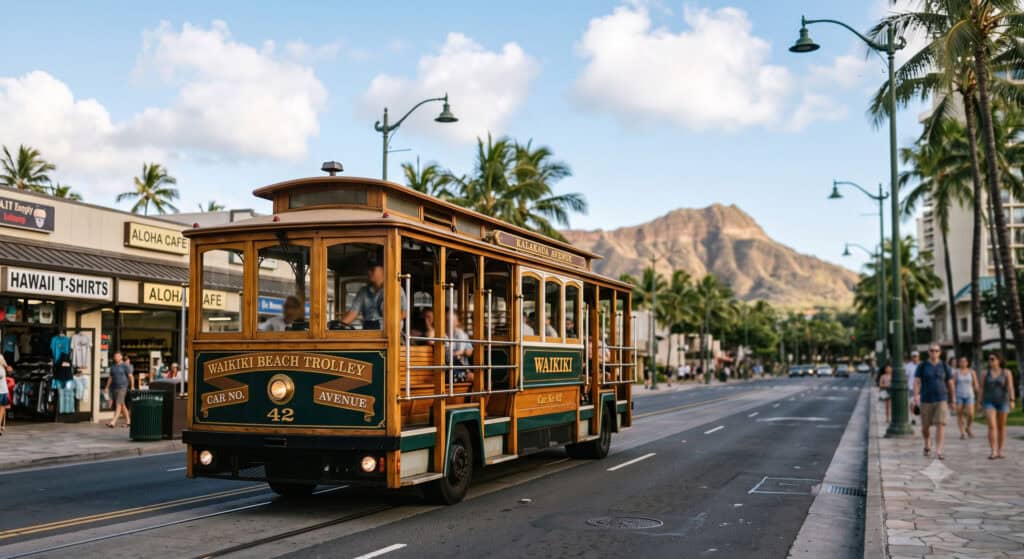
The Waikiki Trolley is the tourist’s transportation: open-air cars and double-deckers with live commentary from local drivers who actually know the island. Unlike TheBus, the routes are built around what visitors want to see rather than where residents need to go. As of 2026, five color-coded lines cover the main Waikiki and Honolulu highlights. For the full breakdown of routes, schedules, and which pass makes the most sense for your trip, see our detailed Waikiki Trolley guide.
- Pink Line (Waikiki / Ala Moana Shopping Loop): $6 flat per day. Runs every 15 minutes between Waikiki hotels and Ala Moana Center. This is one of the best transportation deals in Waikiki, period.
- Blue Line (Coast Line & Local Grinds): East along the coast to Halona Blowhole, Hanauma Bay overlook, and Sea Life Park. Single-day pass: $35 adult / $23 child. Trolleys run every 40 minutes, so plan your stops in advance — you don’t want to miss one at a remote coastal stop with no shade.
- Red Line (Historic Honolulu): Iolani Palace, King Kamehameha Statue, Chinatown, Foster Botanical Garden, and Punchbowl Crater.
- Green Line (Diamond Head Express): Direct trolley to Diamond Head Crater with stops at the Honolulu Zoo and Waikiki Aquarium. Note: the trolley drops you at the trailhead, not the summit — you still need a separate state park reservation to hike.
- Yellow Line (Kakaako Farmers Market — Saturdays only): A Saturday morning-only route from Waikiki through Kakaako to the Kakaako Farmers Market, with stops at SALT Kakaako and Ward Village. Runs roughly 8 AM–11 AM. Parking in Kakaako on a Saturday is a reliable nightmare — this is the smarter option.
All-Lines pass pricing (2026): 1-Day All Lines — approximately $64 adult / $35 child (includes a free bonus day, so you get two days of access). 4-Day All Lines — $76 adult, best value for a typical Waikiki trip. Children under 3 ride free on all lines. Tickets and passes are available at the Waikiki Shopping Plaza booth (2250 Kalakaua Ave, open daily 8 AM–5 PM), from any driver, or online before your trip.
One thing worth flagging: the Waikiki Trolley does not serve the airport or Pearl Harbor. Use TheBus or a dedicated shuttle for both of those.
Biki Bike Share: Short Hops on Two Wheels
Biki is Honolulu’s bike-share network, with about 130 aqua-blue stations running from Iwilei to Diamond Head. It works best for short distances where walking feels too far and calling a rideshare feels like overkill — beach to dinner, hotel to Ala Moana, morning ride along the waterfront.
2026 plans: One-Way ride is $4.50 for 30 minutes, with $5.25 charged for every additional 30 minutes. The Free Spirit plan — $55 for 300 minutes usable anytime over a year — is the best deal for most visitors. To use it, walk up to any kiosk, tap your plan, pay by credit card (no cash), and pull a bike when the green light appears on the dock. When you’re done, push the bike firmly into any station dock until you see the green light. If the station is full, move to the next one. And yes, confirm that green light before walking away — an improperly docked bike keeps charging you.
Waikiki and Ala Moana both have protected bike lanes along Kalākaua Avenue and King Street. The bikes are heavy city cruisers built for durability over speed, but for a sunset ride to Magic Island or a morning loop before the beaches fill up, they’re hard to beat. Avoid sidewalk riding in business districts — it’s illegal — and helmet up if you have one.
Rideshare, Taxis, and Airport Shuttles
Rideshare (Uber, Lyft, and Holoholo)
Rideshare works exactly like it does on the mainland, with a few O’ahu-specific notes. Airport pickups are on Level 1 (ground level) as of late 2025 — follow the signs to the designated rideshare zones at Terminal 1 and Terminal 2, not the old Level 2 area. Surge pricing is real: when several international flights land simultaneously (often early morning and late evening), you’ll see 1.5–2x rates. Wait 10–15 minutes and check again, or use a pre-booked shuttle if you’d rather have a flat rate.
Typical rides within Waikiki run $8–$15. Airport runs are $25–$50 depending on demand. A local alternative worth knowing: Holoholo, a Hawaii-owned rideshare with fixed pricing and no surge. It’s bookable through the SpeediShuttle platform.
Taxis
Taxis are still a solid option — particularly late at night when app availability gets spotty or you don’t feel like navigating a pickup zone on a dying phone. At HNL, taxi service is available on the center median in front of baggage claim, managed by AMPCO Express dispatchers in yellow shirts. Some companies offer flat rates for pre-arranged Waikiki runs; ask before you get in. Tips are customary, especially if the driver helps with heavy bags.
Pre-Booked Airport Shuttles
If you want flat-rate predictability with luggage help and zero driving, a pre-booked shared shuttle is often the right call. Roberts Hawaii Express Shuttle operates an on-demand booth in baggage claim (yellow aloha shirts) at roughly $18–$20 per person one-way. SpeediShuttle offers both shared and private transfers with flight tracking built in, so they’re ready even when your flight is delayed.
The trade-off: shared shuttles make multiple hotel stops. What’s a 25-minute Uber often becomes 45–60 minutes by shuttle. For solo travelers or budget-minded couples, that’s usually fine. Groups of three or more often find that splitting a rideshare comes out cheaper and faster.
A 5-Day Car-Free Waikiki Itinerary That Actually Works
Here’s how a typical visitor week shapes up using the options above. This assumes you buy a 7-day HOLO pass ($45) on Day 1 and add a Trolley day pass as needed.
Day 1 — Arrival: Land at HNL. Grab a HOLO card at the Skyline vending machine or the ABC Store near baggage claim. Board the W Line bus to Waikiki: $3, about 45 minutes. Walk to your hotel, check in, and hit Waikiki Beach for the sunset. Dinner within walking distance.
Day 2 — Diamond Head and South Shore: Waikiki Trolley Green Line to Diamond Head for an early hike (book your state park reservation before the trip — summer dates sell out). Trolley back for breakfast, then Pink Line ($6) to Ala Moana Center for shopping and lunch. The Makai Market food court inside Ala Moana is one of the better value meals within easy reach of Waikiki.
Day 3 — Downtown and Chinatown: TheBus Route 2 or 13 to Iolani Palace, the King Kamehameha Statue, and a dim sum lunch in Chinatown. Afternoon at Foster Botanical Garden. Bus back to Waikiki by mid-afternoon.
Day 4 — Hanauma Bay and East O’ahu: TheBus Route 22 or Waikiki Trolley Blue Line to Hanauma Bay (reservations required in advance — book two days out via the official site). Continue east to Halona Blowhole and Sandy Beach, then back to Waikiki by mid-afternoon.
Day 5 — Pearl Harbor: TheBus Route 20 from Waikiki, about 75 minutes. The USS Arizona Memorial is free but requires advance reservations through Recreation.gov — the 56-day rolling booking window fills fast, especially in summer. Plan this one before you leave home.
Optional Day — North Shore: This is where most car-free visitors decide to splurge on a single rental. Pick up a car from a Waikiki desk, not the airport. Drive the coastal loop through Haleiwa, Waimea Bay, Sunset Beach, and back through the Dole Plantation. Return by dinner. TheBus Route 60 does the same route for $3 — it takes about two hours each way and the views are genuinely beautiful, but the schedule makes spontaneous stops tricky. See our list of best Oahu day trips from Waikiki for more ideas beyond the North Shore.
Car-Free Tips Before You Go
- Download the DaBus app or Transit app. Both cover real-time TheBus arrivals, Skyline schedules, and Biki availability in one place. The Transit app also shows rideshare options alongside transit, which is useful for quick comparisons.
- Cash fares cost more. HOLO card single rides are $3; cash is $3.25 — and drivers don’t make change. Carry exact change or use the HOLO card.
- TheBus luggage rules are enforced. One medium suitcase plus one carry-on per passenger, nothing blocking aisles or safety areas. For oversized bags, multiple bags, or surfboards, use a shuttle or rideshare instead.
- Skyline runs 4:00 AM to 10:30 PM (trains every 10 minutes during peak hours, every 15 after 8:30 PM). Route 42 covers late-night airport runs after 10:30 PM.
- Don’t assume the Trolley is always faster. Kalākaua Avenue traffic can slow the Pink Line to a crawl on busy evenings — sometimes walking the same stretch is quicker.
Frequently Asked Questions About Getting Around Oahu Without a Car
Do I need a car in Waikiki?
No. Waikiki is small enough to walk end-to-end in under an hour, and TheBus, Skyline, the Waikiki Trolley, Biki, and rideshare cover everything else. Most visitors who stay in Waikiki save $300–$400 per week by skipping the rental car and hotel parking fees. The one exception worth considering: renting a car for a single day if you want to do a real North Shore loop at your own pace.
How much does the HOLO card cost?
The card itself is a one-time $2 fee. Fares effective July 1, 2026: $3 per 2-Hour Pass (single ride on HOLO card), $7.50 daily cap, and $45 for a 7-day pass. Fare capping is automatic — once you hit the daily or weekly cap, you ride free for the rest of that period. Cash riders pay $3.25 per ride, with no change given.
What’s the cheapest way to get from Honolulu Airport to Waikiki?
TheBus W Line at $3 per person is the cheapest option and runs every 10 minutes between the airport and Waikiki, taking about 45 minutes. The catch: luggage is limited to one medium suitcase plus a carry-on per rider, so it works best for light packers. For families or anyone with multiple large bags, a pre-booked shared shuttle ($18–$25 per person) is usually the better trade-off between cost and convenience.
Is the Waikiki Trolley worth it?
For the Pink Line at $6 per day, yes — it’s the cheapest way to hop between Waikiki and Ala Moana Center and is worth it almost any day you plan to shop or eat at the mall. The All-Lines passes ($64 for one day, $76 for four days) earn their cost if you plan to hit multiple attractions like Diamond Head, Iolani Palace, the Halona Blowhole, and Sea Life Park. If you prefer exploring on your own schedule and don’t need narration, TheBus covers most of the same ground for less money.
Can I bring luggage on TheBus?
Yes. Each passenger is allowed one medium suitcase plus one smaller carry-on at no extra charge, with the restriction that bags can’t block aisles or safety areas. For very large bags, multiple pieces, or awkward items like surfboards, use a shuttle or rideshare — drivers can and do refuse boarding for oversized items.
Is Biki safe for beginners?
For the most part, yes. Waikiki has protected bike lanes along Kalākaua Avenue and King Street, and Honolulu drivers are generally bike-aware in those areas. The bikes are heavy city cruisers built for stability rather than speed. A few things to keep in mind: sidewalk riding is illegal in business districts, always confirm the green light on the dock when you return the bike (an improperly returned bike keeps charging you), and helmet up if you have one — the stations don’t provide them.
Between a $2 HOLO card, a $45 weekly pass that covers buses and trains across the entire island, a $6 Pink Line trolley for Ala Moana runs, and the occasional rideshare for late nights and luggage, most Waikiki visitors can have a full week on O’ahu for roughly what a rental car alone would cost. Skip the rental counter, skip the parking garage, and use that money on what you actually came here for.
Planning your first trip? Start with our first-timer’s guide to Waikiki — it covers everything from when to go to how to budget your week.