
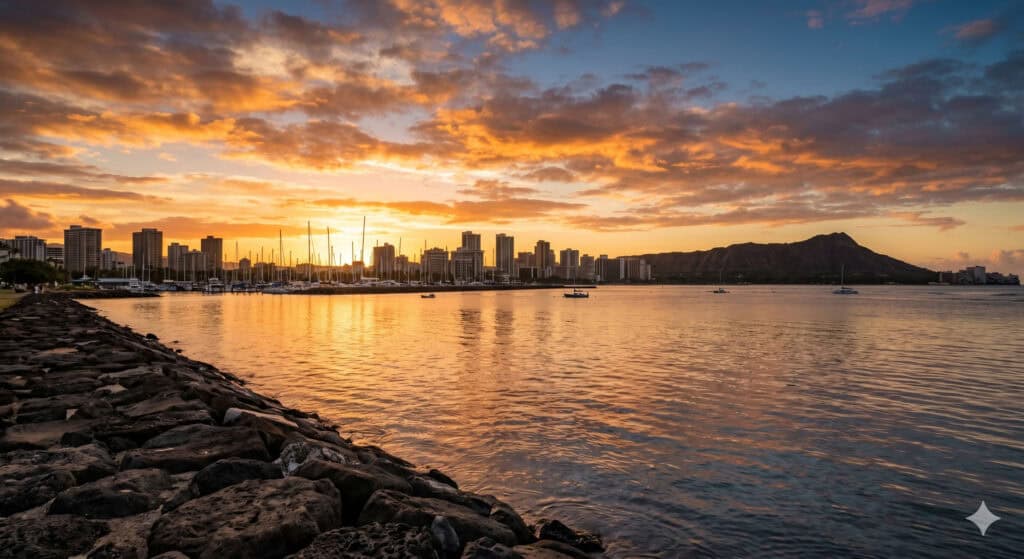
Most visitors to Waikiki photograph sunset from the exact same spot: standing at the water’s edge, somewhere along the main stretch of beach, shooting straight into the orange glow over the Pacific. The photos are beautiful. They’re also nearly identical to a million others taken from the same angle, the same week, by someone with the same phone case. If you’ve got a camera around your neck — or even just a phone you actually care about — you can do a lot better than that. Oahu has some of the best sunset photography locations in the Pacific, and most of them have no line, no crowd, and no influencer with a ring light blocking your shot. This guide covers the best sunset spots for Waikiki photography, from the iconic to the genuinely hidden, with specific timing, GPS coordinates, gear notes, and composition tips for each one.
Why Oahu Sunsets Are Such a Big Deal for Photographers
Honolulu sits at roughly 21 degrees north latitude, which means the sun tracks across a wide arc of sky and sets relatively slowly, especially in summer. During May through August, sunset in Waikiki typically falls between 7:10 and 7:30 PM HST, giving you a generous golden hour that starts around 6:15 PM and bleeds into a long, colorful blue hour afterward. That extended transition window — warm orange light giving way to deep magenta, then that soft electric blue — is what makes Hawaiian sunsets so rewarding to photograph. Winter visitors get an earlier sunset closer to 6:00 PM, but the lower sun angle can produce even more dramatic colors when clouds are right.
The trade winds also help. Clouds drift in from the northeast and tend to catch fire near the horizon at dusk, adding texture to shots that might otherwise be a clean but flat gradient. The west-facing coastline of Waikiki is perfectly aligned for sunset shooting, but the best vantage points aren’t always the obvious ones. As part of planning your Waikiki trip, blocking out one specific evening for a dedicated sunset shoot — with a destination already in mind — will always beat wandering the beach hoping for a gap in the crowd.
Magic Island: The Best Sunset Spot for Waikiki Photography
Magic Island — officially the peninsula tip of Ala Moana Regional Park — is the single best sunset photography location within easy reach of Waikiki. The GPS coordinates for the shooting area are approximately 21.2913° N, 157.8570° W, right at the Diamond Head-facing shoreline. What makes it work: you get Waikiki’s famous skyline and the Diamond Head silhouette together in one frame, sailboats and outrigger canoes coming in off the water, and a calm lagoon-side that creates excellent reflection shots in the thirty minutes after sunset when the water is glassy.
Arrive by 6:00 PM on any evening to claim a good position. Walk all the way to the ocean-facing point of the peninsula — most visitors stop at the grassy area and miss the best angle entirely. The Diamond Head side of the point gives you the iconic skyline shot; the Honolulu side gives you marina lights and a more urban silhouette. On Friday evenings, the Hilton Hawaiian Village’s weekly fireworks display goes off shortly after sunset, which turns this already great spot into something spectacular. Bring a tripod if you have one — a wide-angle lens in the 16-24mm range handles the scene well, and a polarizing filter will help manage the glare during the hour before sunset.
Ilikai Marina: Reflections, Sailboats, and Almost No Competition
The Ilikai Marina sits at 21.2890° N, 157.8470° W, right at the western edge of the Waikiki strip near the hotel of the same name — Oahu’s first luxury high-rise, which opened in 1964. Most tourists walk past the marina without a second look. That’s a mistake. At sunset, the calm water catches every shade of color overhead, sailboat masts create natural leading lines toward the horizon, and the scene has a peaceful, almost cinematic quality that you simply cannot get from the main beach.
The best shooting position is from the walkway along the marina’s edge. Try standing across the street at the corner near the ABC Store and shooting toward the hotel with a wide or medium focal length — traffic and pedestrians become part of the composition rather than a nuisance. For long-exposure work, the calm water here is far more cooperative than open ocean. If you’re staying nearby and looking for more ways to spend the evening, our guide to the best restaurants in Waikiki has good options for pairing a sunset shoot with a memorable dinner.
Round Top Drive & Puu Ualakaa State Wayside: Sunset From Above
For an elevated perspective on Honolulu and Waikiki at sunset, the Puu Ualakaa State Wayside lookout on Round Top Drive is the answer. The coordinates for the main lookout are approximately 21.3144° N, 157.8268° W, reached via a scenic winding road about 20 minutes from Waikiki. From this vantage point — roughly 1,048 feet above sea level — you can see Diamond Head, the city skyline, Pearl Harbor in the distance, and the full sweep of the south Oahu coastline. As the sun drops, the city lights begin to flicker on below you, and for about fifteen minutes, you have both a colorful sky and a glowing city in the same frame. That’s a rare combination anywhere in the world.
Drive time from Waikiki is about 20–25 minutes, but account for the fact that the road is narrow, winding, and popular with cyclists and joggers. Arrive 45 minutes before sunset to scout the lookout and settle into position. The park officially closes at 7:45 PM, so double-check current hours before you go. A telephoto lens lets you compress the cityscape beautifully; a wide-angle will capture the full panorama but can make distant features look small. Our 20 best Waikiki day trips guide covers Round Top and Tantalus for anyone who wants to combine the drive with other sightseeing earlier in the day.
China Walls (Portlock): Lava Rock Ledges and Dramatic Ocean Light
China Walls sits at approximately 21.2758° N, 157.7042° W on the southeastern tip of Oahu, in the upscale Portlock neighborhood about 25 minutes from Waikiki. This is a cliff-jumping spot for locals, but for photographers it’s something different: a jagged lava-rock shoreline where the ocean crashes hard against dark stone, creating dynamic foreground for sunset shots with a wide Pacific horizon. The combination of deep blue water, black lava, and a sky going orange and pink overhead is one of the most striking natural compositions on the island.
This is not a beginner spot. The ledges can be slippery, there are no lifeguards, and you need to be aware of wave conditions at all times — this coastline is powerful and unpredictable. Keep your camera gear away from the edge and never turn your back to the ocean. That said, for experienced photographers comfortable in rugged environments, the shots here are worth the extra effort to get out there. The drive itself is easy and parking is found on nearby residential streets. If you’re planning to explore this part of the coast, our Koko Crater trail guide covers another spectacular location a short drive away for the same adventurous day.
Kuilei Cliffs Beach Park: Diamond Head Silhouettes at Dusk
Kuilei Cliffs Beach Park, located at approximately 21.2610° N, 157.7950° W along Diamond Head Road, is the spot that most sunset-chasing photographers miss entirely. The park is a narrow strip of shoreline at the base of Diamond Head’s south face. During the day, surfers and windsurfers dominate it. At sunset, they thin out — and the ones who stay become perfect silhouettes against the glowing sky, riding waves with Diamond Head towering above them. It’s a ready-made composition that looks like it took serious scouting to find.
Park along Diamond Head Road and walk down to the shore. The beach itself is rocky and not ideal for swimming, but for photography it’s excellent. The angle here faces roughly southwest, which means the sunset is behind you and to your right in midsummer — you’re actually shooting into the golden sidelight falling on Diamond Head’s face, rather than straight into the sun. That light quality, warm and directional, is what separates a good landscape shot from a great one. If you’re planning to hike Diamond Head itself on the same trip, our complete guide to Diamond Head covers everything you need to know about the monument, trail, and timing.
Gear, Timing, and Composition Tips for Oahu Sunset Photography
Golden hour in Waikiki typically runs from about 45 minutes before sunset until just at the moment the sun touches the horizon. Blue hour — the soft, diffuse, deeply colored period that follows — lasts another 20 to 30 minutes after sunset and is often more photogenic than the sunset itself, especially for cityscapes and reflections. If you’re only showing up at sunset and leaving when the sun disappears, you’re leaving the best light on the table.
Gear-wise, a wide-angle lens in the 16–24mm range handles panoramic beach and skyline shots well. A 70–200mm telephoto is useful for compressing distant elements — the Diamond Head silhouette, surfers on waves, the city skyline from Puu Ualakaa — making them appear larger and more dramatic in the frame. A tripod is essential for blue-hour work, long exposures on the marina reflections, or anything shot below ISO 800. Graduated neutral density (GND) filters help balance the bright sky against a darker foreground, though you can achieve similar results in post-processing with bracketed exposures. If you’re traveling light, a simple phone clamp for a small travel tripod will cover most of these situations.
On drone use: this comes up constantly and the answer is more restricted than most visitors expect. Waikiki Beach itself falls within controlled airspace, and flying there without FAA authorization via LAANC is not permitted. Hawaii state parks — including Diamond Head State Monument — prohibit drone launching and landing entirely. Recreational drones over 0.55 lbs must be registered with the FAA, and pilots must pass the TRUST safety test before flying recreationally. Check the B4UFLY app before every flight to confirm current airspace status for your specific location. Violations can carry significant fines, and some of the most tempting spots are also the most regulated. For a complete look at how to spend your time on the island, including activities that pair well with a sunset shoot, our 10-day Waikiki itinerary is a good starting point.
Frequently Asked Questions About Sunset Photography in Waikiki
What time is sunset in Waikiki?
Sunset in Waikiki falls between approximately 7:10 and 7:30 PM HST during the spring and summer months (May through August). In winter, sunset arrives earlier — closer to 6:00 PM from November through January. Golden hour photography typically begins 45 to 60 minutes before sunset, and blue hour extends 20–30 minutes after the sun drops below the horizon.
Can you fly a drone at Waikiki Beach for photography?
Not without FAA authorization. Waikiki Beach falls within controlled airspace, which means recreational drone flight requires approval through the FAA’s LAANC system. Hawaii state parks, including Diamond Head, prohibit drone launching and landing altogether. Commercial drone pilots must hold an FAA Part 107 Remote Pilot Certificate. Always check the B4UFLY app before flying anywhere on Oahu.
What is the best location for sunset photography in Waikiki?
Magic Island (the tip of Ala Moana Regional Park) is widely considered the best single location for sunset photography near Waikiki, offering the Waikiki skyline, Diamond Head, sailboats, and reflective calm water all in one frame. For elevated views above the city, the Puu Ualakaa State Wayside lookout on Round Top Drive is exceptional. For dramatic ocean and lava-rock compositions, China Walls in Portlock is the top choice.
How early should I arrive at a sunset photography spot in Waikiki?
Aim to arrive at least 45 minutes to an hour before sunset. This gives you time to scout your position, test compositions, and be ready when the light turns golden. At popular spots like Magic Island on a Friday evening, arriving earlier than that is smart — the fireworks draw a crowd. At more remote locations like China Walls, arriving early also gives you time to assess wave conditions safely before committing to a shooting spot.
Is there parking at the best Oahu sunset photography locations?
Magic Island and Ala Moana Beach Park have a large parking lot off Ala Moana Boulevard, which is free and generally available (though it fills on busy evenings). Puu Ualakaa State Wayside has a small lot at the lookout. China Walls requires street parking in the Portlock residential neighborhood — be respectful of neighbors and park legally. Kuilei Cliffs Beach Park has limited roadside parking along Diamond Head Road.
What camera gear do I need for Waikiki sunset photography?
A wide-angle lens (16–24mm) handles broad beach and skyline shots well. A telephoto (70–200mm) is useful for compressing distant features like Diamond Head or the city skyline from elevated viewpoints. A tripod is essential for blue-hour shots and long exposures on reflective water. A graduated ND filter helps balance bright skies against dark foregrounds. A smartphone with a good camera app (especially one that supports manual exposure and RAW capture) can produce excellent results at all of these locations.
The best camera is always the one you have with you — but having even a rough location plan before you head out will do more for your photos than any piece of gear. Pick one spot per evening, arrive with time to explore it properly, and stay through blue hour. That formula, more than anything else, is what separates a great Waikiki sunset shot from the thousands of identical ones taken from the same stretch of sand every night.