June is when Oahu stops being just a beach destination and becomes something genuinely special. Two of Hawaii’s biggest cultural events land in the same stretch of days: King Kamehameha Day, the only U.S. state holiday honoring a monarch, and the Pan-Pacific Festival, a three-day celebration of Pacific Rim culture that shuts down Kalakaua Avenue not once but twice. Both are free. Both are spectacular. And most visitors have no idea either is happening until they walk into the crowds. If you’re finalizing Oahu events for June 2026, here’s the full breakdown — confirmed dates, times, parade routes, parking strategy, and what’s actually worth your time.
King Kamehameha Day 2026: Hawaii’s Only Royal Holiday
June 11 is a state holiday in Hawaii — and the only public holiday in the United States that honors a monarch. King Kamehameha I, born around 1758 in North Kohala on the Big Island, unified the Hawaiian Islands through decades of military campaigns and diplomacy. By 1810, the entire archipelago was under a single kingdom. That achievement is still celebrated more than two centuries later, and on Oahu in 2026, the celebration stretches across three days with three very different events.
June 11 — The Tribute Ceremony at Aliʻiōlani Hale
The state holiday opens with a formal tribute ceremony at the King Kamehameha I statue in front of Aliʻiōlani Hale (417 S. King St., downtown Honolulu), running from 9:00 to 9:30 a.m. It’s short and ceremonial, attended mostly by members of Hawaiian cultural organizations. If you’re already downtown or an early riser, it’s a meaningful fifteen minutes. If not, the bigger events on Friday and Saturday are worth saving your energy for.
June 12 — The Lei Draping Ceremony
Friday afternoon is the emotional centerpiece of Kamehameha Day on Oahu. From 2:30 to 5:00 p.m. at Aliʻiōlani Hale, the 18-foot bronze Kamehameha statue is draped in long cascading strands of fresh flower lei — a tradition that dates back to 1901. The lei hang from the statue’s outstretched arm in ropes of yellow and white, and the visual effect is genuinely moving. Spectators line King Street throughout the afternoon. You don’t need to arrive at 2:30 sharp; the lei display stays up after the ceremony and can be viewed as the afternoon winds down. Wear comfortable shoes — there’s no seating, and you’ll be standing on pavement in the sun.
June 13 — The Floral Parade and Hoʻolauleʻa Block Party
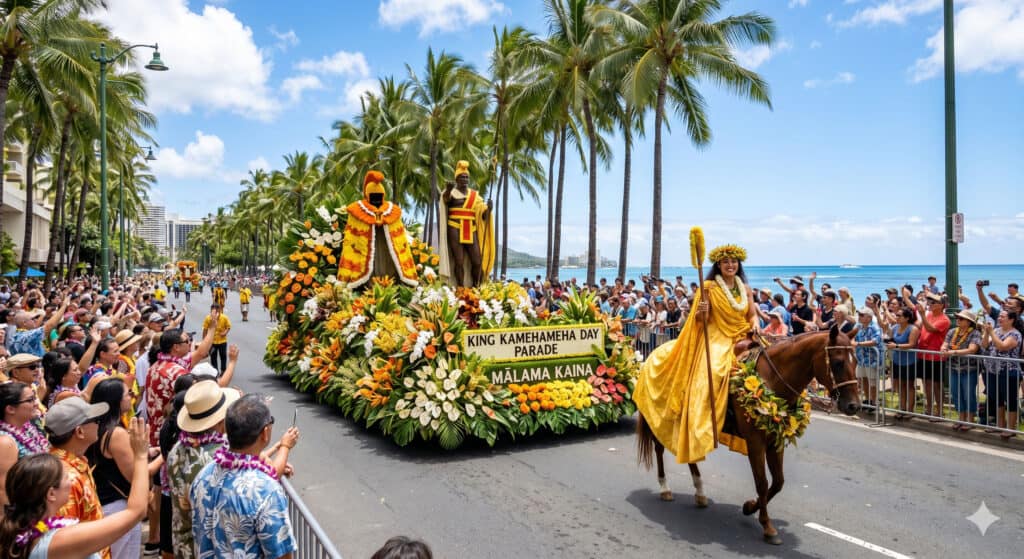
Saturday is the main event. According to the State Foundation on Culture and the Arts, the 109th annual King Kamehameha Celebration Floral Parade steps off from ʻIolani Palace at 9:00 a.m. and finishes at Kapiʻolani Park around 1:00 p.m. The route runs through downtown Honolulu, past the harbor, through Kakaʻako and Ala Moana, and down Kalākaua Avenue through Waikiki. What makes it different from a standard parade: the pāʻū riders. These are women on horseback in elaborate flower-covered gowns and lei, each representing one of the Hawaiian Islands — a tradition rooted in the royal court. The Royal Hawaiian Band, the oldest municipal band in the United States, performs. Floats are constructed from native Hawaiian flowers and plants.
After the parade, the Hoʻolauleʻa block party runs from 11:00 a.m. to 5:00 p.m. at Queen Kapiʻolani Park — food booths, hula performances, live music, games, and cultural demonstrations. If you want both, claim your parade spot along Kalākaua by 9:00 a.m., then walk over to the park as the Ho’olaule’a gets going around 11:00. You’ll be in the same neighborhood the whole time. Comfortable walking shoes and a hat are non-negotiable.
Pan-Pacific Festival 2026: Three Days of Free Culture in Waikiki
The 43rd Pan-Pacific Festival runs June 12–14, 2026, from Ala Moana Center through Waikiki. It started in 1980 as “Matsuri in Hawaii,” a cultural exchange between Hawaii and Japan during a period of strong ties between the two. By 1996, it expanded to include cultures across the Pacific Rim and became the Pan-Pacific Festival. This year’s theme is “Celebrating One Ocean, Many Cultures.” Every event — every performance, the block party, the parade — is completely free. For more information and the current performance schedule, visit the official Pan-Pacific Festival website.
Friday, June 12 — The Hoʻolauleʻa Block Party
The Ho’olaule’a runs from 7:00 to 10:00 p.m. on Kalākaua Avenue between Seaside and Uluniu avenues. The street closes to traffic at 5:00 p.m., and vendors set up early. Expect plate lunches, musubi, takoyaki, shave ice, mochi, and a generally excellent crowd. Before the block party, the Pan-Pacific Hula Festival at Kūhiō Beach Hula Mound runs 5:00–7:00 p.m. — free, right near the Duke Kahanamoku statue, and a low-key way to ease into the evening. The block party itself is high-energy and family-friendly, and it ends at a reasonable hour. If you haven’t planned dinner yet, the food vendors here are your dinner.
Saturday, June 13 — Cultural Stages All Day
Saturday programming runs across Ala Moana Centerstage, International Market Place, and the Kūhiō Beach Hula Mound simultaneously. The Hula Festival at Kūhiō Beach runs 4:30–9:00 p.m., featuring hālau from both Japan and Hawaii performing traditional and contemporary hula. Taiko drumming, traditional Japanese dance, Korean cultural performances, and ukulele groups fill the other stages throughout the day. Saturday is also King Kamehameha Parade day — so if you plan it right, the morning gives you the floral parade ending at Kapiʻolani Park, and the afternoon flows directly into Pan-Pacific programming a few blocks away. No car needed; everything is walkable.
Sunday, June 14 — The Pan-Pacific Parade
The Pan-Pacific Parade is the festival’s grand finale — Okinawan performers, taiko drummers, Korean traditional dance groups, hula dancers, high school marching bands, lion-dragon dancers, steel pan musicians, and beauty queens from across the Pacific, all marching down Kalākaua Avenue from Fort DeRussy Park to Kapiʻolani Park. Kalākaua closes starting at 4:00 p.m., so adjust any dinner reservations or car pickups accordingly. The best viewing spots are along the full stretch of Kalākaua; bring a folding chair or mat, because the sidewalk fills up. Arriving 45–60 minutes before the road closure gives you a solid spot and gets you into the pre-parade energy, which is half the fun.
Logistics: Parking, Getting There, and Timing Both Events
The June 12–13 overlap is actually a gift for planning. Both festivals operate in the same general zone — Ala Moana to Kapiʻolani Park — so you don’t need to choose. Friday evening is Pan-Pacific block party. Saturday morning is the King Kamehameha Floral Parade, with the Ho’olaule’a running through the afternoon at Kapiʻolani Park while Pan-Pacific stages run concurrently. Sunday is the Pan-Pacific Parade. Three days, one neighborhood, two festivals, zero admission cost.
Parking is tight on event weekends. Kalākaua street parking disappears during road closures, and hotel garages in Waikiki run $6–$10 per hour. Your best bet is Ala Moana Center’s parking garage — free with a purchase validation, easy access, and a short walk or quick bus ride to most festival venues. Arrive before 9:00 a.m. on parade days to beat the rush. TheBus lines 2 and 13 from Waikiki put you within easy walking distance of everything. If your hotel sits along Kalākaua, leave the car and walk — festival weekend is built for pedestrians. For a broader look at things to do in Waikiki before or after the festivals, our guide covers the rest of the island’s best activities and how to fit them in.
More June Events Worth Knowing About on Oahu
The King Kamehameha celebrations and Pan-Pacific Festival get the headlines, but June has more going on. The King Kamehameha Hula Competition at the Neil S. Blaisdell Center is a two-day competitive event that draws hula groups from around the world to Honolulu — prizes awarded the second night, and serious artistry throughout. Dates vary; check the Blaisdell Center’s calendar if competitive hula is on your radar.
Mango Jam Honolulu brings a downtown celebration of mango season — food booths, live entertainment, a farmer’s market, and craft vendors in a relaxed, local setting. It’s a genuinely fun afternoon that tends to slip under the tourist radar, which means shorter lines and better prices on everything. Obon season also begins in June and runs through August: almost every weekend, a different Japanese Buddhist temple holds an evening of taiko drumming and bon odori folk dancing, open to the public with no ticket required. Times and locations shift week to week, so check local listings close to your trip. If you’re building out your full Oahu itinerary around these festivals, our 5-day Waikiki itinerary maps out a balanced week that leaves room for event days. For longer trips, the best day trips from Waikiki gives you options for exploring beyond the festival zone.
What to Bring to June Festivals in Waikiki
Parade days mean hours on pavement in the sun. June in Waikiki runs warm — mid-80s most days with trade winds — but the sun is strong and there’s nowhere to hide during a parade. Here’s what actually makes a difference:
- Sunscreen — reapply every 90 minutes on parade days; SPF 50 minimum
- Folding chair or lightweight blanket — both parades draw full sidewalks fast
- Cash — not all food vendors accept cards, and the festival food is worth it
- Refillable water bottle — you’ll drink more than you expect standing in the sun
- Comfortable walking shoes — festival venues stretch over a mile of street
- Light jacket for evening — trade winds pick up after sunset and the Pan-Pacific block party runs until 10:00 p.m.
- Full phone charge and a portable battery pack — you’ll be shooting a lot of video
Festival weekends fill up the good restaurant tables fast. Book ahead if you have specific spots in mind — especially anything along Kalākaua or in the Kapiʻolani Park area. For solid pre-parade dinner options and timing that works around a 9:00 a.m. parade start, our guide to the best happy hours in Waikiki has early-opening spots that work well for a relaxed meal before the crowds arrive.
Frequently Asked Questions About Oahu June Events
When is the King Kamehameha Day Floral Parade in 2026?
The 109th King Kamehameha Celebration Floral Parade is on Saturday, June 13, 2026. It departs from ʻIolani Palace at 9:00 a.m. and finishes at Kapiʻolani Park around 1:00 p.m. The state holiday itself falls on Thursday, June 11. The lei draping ceremony at the Kamehameha statue takes place Friday, June 12, from 2:30 to 5:00 p.m.
Is the Pan-Pacific Festival free to attend?
Yes — every Pan-Pacific Festival event is free, including the Friday Ho’olaule’a block party, the Hula Festival at Kūhiō Beach, all cultural stage performances at Ala Moana and International Market Place, and the Sunday parade. Food vendors charge for food, but entry to every event is open to the public at no cost.
Where is the best spot to watch the Pan-Pacific Parade?
Anywhere along Kalākaua Avenue with a clear sightline works. The blocks between Fort DeRussy and the Kūhiō Beach area fill up fastest. Arrive 45–60 minutes before Kalākaua closes (4:00 p.m.) with a folding chair or mat to secure a comfortable spot. The Diamond Head end of the route offers better afternoon light for photos.
Is the King Kamehameha Floral Parade good for kids?
Very much so. The parade features colorful flower-covered floats, pāʻū riders on horseback dressed in elaborate lei gowns representing the Hawaiian Islands, and marching bands — all visually engaging for kids. The post-parade Hoʻolauleʻa at Kapiʻolani Park adds food vendors, games, and hula performances that stretch the day into early afternoon.
What is the Pan-Pacific Festival Hoʻolauleʻa?
The Ho’olaule’a is the Pan-Pacific Festival’s Friday night block party, running 7:00–10:00 p.m. on Kalākaua Avenue between Seaside and Uluniu avenues. Kalākaua closes to traffic at 5:00 p.m. Food vendors, live performances, and cultural programming take over the street. It’s the festival’s most energetic single event and a great entry point for first-timers.
Do I need tickets for the June 2026 festivals on Oahu?
No tickets are needed for the King Kamehameha tribute ceremony, lei draping, or floral parade. No tickets are needed for any Pan-Pacific Festival event — the block party, Hula Festival, cultural performances, and Sunday parade are all walk-in and free. The post-parade Hoʻolauleʻa at Kapiʻolani Park (Kamehameha Day) is also open without charge.
June in Waikiki has always been underrated as a travel window — warm weather, manageable crowds compared to peak July and August, and now two of the year’s best cultural events stacked into the same long weekend. Lock in June 12–14 and plan around it. For more on what’s worth adding to your Waikiki nights, a luau pairs naturally with a festival-heavy days-side itinerary.