June is the month Oahu stops being just a beach destination. Every year, two of Hawaii’s biggest cultural celebrations land within days of each other: King Kamehameha Day, the only U.S. state holiday honoring a monarch, and the Pan-Pacific Festival, a three-day celebration of Pacific Rim culture that shuts down Kalākaua Avenue twice in one weekend. Both are free. Both are spectacular. And most visitors have no idea either is happening until they walk into the crowds. This guide to Oahu June events covers how the month works every single year — the fixed dates, the recurring patterns, the parade routes, and the planning moves that separate a great festival trip from an afternoon stuck in traffic.
King Kamehameha Day: The Royal Holiday That Anchors June
June 11 is King Kamehameha Day, a Hawaii state holiday every year without exception — the only public holiday in the United States dedicated to a monarch. King Kamehameha I, born around 1758 in North Kohala on the Big Island, unified the Hawaiian Islands through decades of military campaigns and diplomacy, bringing the entire archipelago under a single kingdom by 1810. More than two centuries later, Oahu still marks the occasion with three distinct events spread across several days, coordinated by the King Kamehameha Celebration Commission.
The pattern holds year after year. A short tribute ceremony takes place at the King Kamehameha I statue fronting Aliʻiōlani Hale (417 S. King St., downtown Honolulu) on or around the holiday itself — fifteen ceremonial minutes, attended mostly by Hawaiian cultural organizations. The lei draping ceremony follows on a nearby afternoon, when the 18-foot bronze statue is draped in long cascading strands of fresh flower lei, a tradition dating back to 1901. The lei hang from the statue’s outstretched arm in ropes of yellow and white, and the display stays up after the ceremony ends, so you don’t need to arrive the minute it starts.
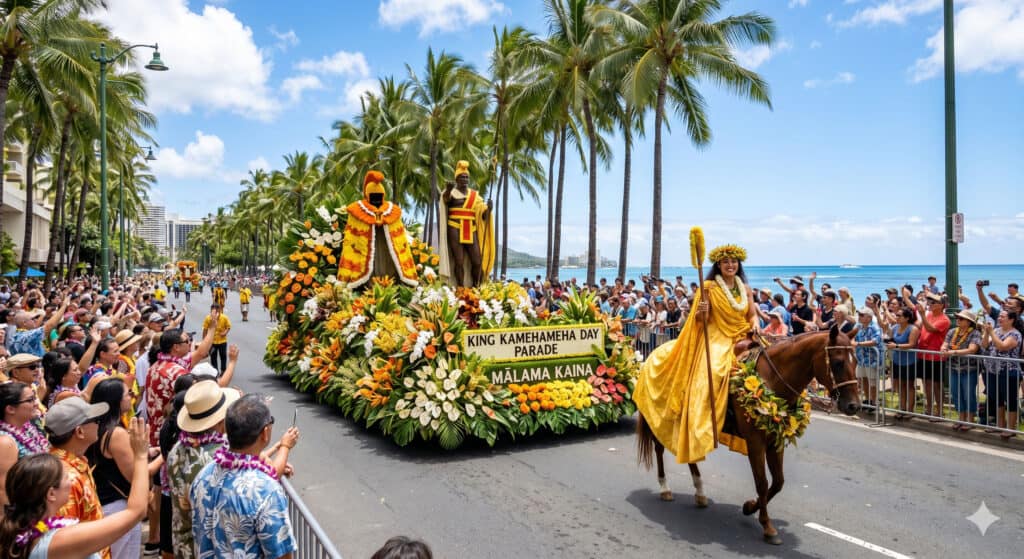
The main event is the King Kamehameha Celebration Floral Parade, held on a Saturday close to the holiday — typically the second Saturday of June. It steps off from ʻIolani Palace at 9:00 a.m. and finishes at Kapiʻolani Park around 1:00 p.m., running through downtown Honolulu, past the harbor, through Kakaʻako and Ala Moana, and down Kalākaua Avenue through Waikiki. What sets it apart from a standard parade: the pāʻū riders — women on horseback in elaborate flower-covered gowns and lei, each representing one of the Hawaiian Islands, a tradition rooted in the royal court. The Royal Hawaiian Band, the oldest municipal band in the United States, performs, and the floats are built from native Hawaiian flowers and plants. A Hoʻolauleʻa block party with food booths, hula, and live music follows at Kapiʻolani Park through the afternoon.
The Pan-Pacific Festival: Waikiki’s Free Cultural Weekend
The Pan-Pacific Festival runs three days every June, usually the weekend closest to Kamehameha Day — which means the two celebrations often overlap into one packed festival stretch. It started in 1980 as “Matsuri in Hawaii,” a cultural exchange between Hawaii and Japan, expanded in 1996 to cover cultures across the Pacific Rim, and came back strong in 2024 after a five-year hiatus. Every event is free: the performances, the block party, the parade, all of it. Current-year dates and the full performance schedule are posted on the official Pan-Pacific Festival website.
The rhythm is the same each year. Friday night brings the Hoʻolauleʻa block party on Kalākaua Avenue between Seaside and Uluniu avenues — the street closes to traffic in the late afternoon, and by evening you’re weaving between plate lunch vendors, takoyaki stands, shave ice, and live stages. Saturday spreads cultural programming across Ala Moana Centerstage, International Market Place, and the Kūhiō Beach Hula Mound, with hālau from both Japan and Hawaii performing traditional and contemporary hula alongside taiko drumming, Korean dance, and ukulele groups. Sunday closes with the Pan-Pacific Parade down Kalākaua from Fort DeRussy to Kapiʻolani Park: Okinawan performers, lion-dragon dancers, marching bands, steel pan musicians, and hula dancers, with the road closing in the late afternoon ahead of the step-off.
When the calendars align — and they usually do — the combination is hard to beat. Friday evening at the block party, Saturday morning at the floral parade, Saturday afternoon bouncing between cultural stages, Sunday at the Pan-Pacific Parade. Three days, one walkable neighborhood, two festivals, zero admission cost.
More Oahu June Events Worth Planning Around
The headliners get the attention, but June keeps going after the parades. The King Kamehameha Hula Competition at the Neal S. Blaisdell Center draws hula groups from around the world to Honolulu for two days of serious competitive artistry — dates shift annually, so check the Blaisdell calendar if it’s on your radar. Mango Jam Honolulu celebrates mango season downtown with food booths, live entertainment, and craft vendors in a relaxed local setting that tends to slip under the tourist radar, which means shorter lines and better prices on everything.
Obon season also begins in June and runs through August. Almost every weekend, a different Japanese Buddhist temple somewhere on the island hosts an evening of taiko drumming and bon odori folk dancing, open to the public with no ticket required — times and locations shift week to week, so check local listings close to your trip. And no matter which June week you pick, the Friday night fireworks over Duke Kahanamoku Beach are a free standing tradition worth building an evening around.
How to Plan a June Festival Trip
Festival weekends compress a lot of people into a small stretch of Waikiki, and the logistics reward anyone who plans a few weeks ahead. Hotels along Kalākaua fill early for the mid-June weekend, and the good restaurant tables go with them — book both before you land. Parking is the biggest single headache: street parking disappears during road closures and hotel garages get expensive fast. Our Waikiki parking guide breaks down the garages worth using, but the short version is that Ala Moana Center’s garage plus a short walk beats circling Waikiki every time.
Better yet, skip the car entirely. Everything from Ala Moana to Kapiʻolani Park is walkable or a short bus ride, and festival weekend is exactly the scenario where getting around Oahu without a car works in your favor. If you’re building a full week around the festivals, our 5-day Waikiki itinerary leaves room for event days without cramming the rest of the island into the gaps.
What to Bring on Parade Days
June in Waikiki runs warm — mid-80s most days with trade winds — but parade days mean hours on pavement with nowhere to hide from the sun. Here’s what actually earns its place in your bag:
- Sunscreen, SPF 50 minimum — reapply every 90 minutes
- Folding chair or lightweight mat — both parades fill the sidewalks fast
- Cash — not every food vendor takes cards, and the festival food is worth it
- Refillable water bottle — you’ll drink more than you expect
- Comfortable walking shoes — venues stretch over a mile of street
- Light jacket for evening — trade winds pick up after sunset
- Full phone charge plus a battery pack — you’ll shoot more video than you think
Frequently Asked Questions About Oahu June Events
When is King Kamehameha Day?
King Kamehameha Day is June 11 every year — it’s a fixed Hawaii state holiday, not a floating one. The floral parade is held on a Saturday close to the holiday, typically the second Saturday of June, with the lei draping ceremony on a nearby afternoon at Aliʻiōlani Hale in downtown Honolulu.
Is the Pan-Pacific Festival free to attend?
Yes. Every Pan-Pacific Festival event is free, including the Friday block party, the hula festival at Kūhiō Beach, the cultural stage performances, and the Sunday parade. Food vendors charge for food, but entry to every event is open to the public at no cost.
Do I need tickets for Oahu’s June festivals?
No tickets are needed for any of the major June events — the Kamehameha tribute ceremony, lei draping, floral parade, and every Pan-Pacific Festival event are all walk-in and free. The only June events that may require tickets are the King Kamehameha Hula Competition at the Blaisdell Center and some paid seating options at private venues along the parade routes.
What is Obon season in Hawaii?
Obon is a Japanese Buddhist tradition honoring ancestors, and in Hawaii it runs from June through August as a series of weekend festivals at temples across the islands. Each one features taiko drumming, bon odori folk dancing, and food booths, and the public is welcome without tickets. Schedules are published by the individual temples early each summer.
Is June a good month to visit Oahu?
June is one of the best-value months on Oahu: warm, dry weather in the mid-80s, smaller crowds than July and August, and the year’s densest stretch of free cultural events. If you’re weighing early summer options, the festival weekend around June 11 is the strongest argument for going in June rather than waiting.
Whichever June you’re planning, anchor your trip to the weekend nearest June 11 and let the rest of the island fill in around it — the parades and block parties only come once a year. If you want to keep the cultural momentum going after the festivals wrap, a good luau near Waikiki pairs naturally with a festival-heavy itinerary. Check our June vs. July comparison if you’re still deciding when to book.