
You found the flight deal. The hotel looks gorgeous in the photos. Then you hit “confirm booking” and the total lands a few hundred dollars higher than you expected. That’s the short version of Waikiki, and it’s exactly where the real Waikiki vacation downsides start to show up. None of them are dealbreakers. All of them are worth knowing before you book.
Waikiki still earns its reputation as one of the best beach vacations in the country. It just isn’t a flawless one. Cost, stacked taxes, inconsistent food, crowds, a long flight, and a strip that can feel more resort-zone than tropical island — those are the six things that trip up first-timers most. Here’s an honest look at each, updated for 2026, plus what actually works to get around them.
The Six Downsides, Fast
- Cost — almost everything costs more than you budget for
- Taxes and fees — the advertised rate is never the final number
- Food — genuinely good, but easy to get wrong
- Crowds — Waikiki is famous, and it shows
- The flight and jet lag — Hawaii is far from almost everywhere
- It can feel commercialized — the main strip leans resort more than tropical
Each one is manageable once you know what you’re dealing with. Here’s how.
1. Cost: Waikiki Vacation Downsides Start With the Price Tag
Hawaii is a chain of islands in the middle of the Pacific, and nearly everything you buy there — your hotel room, your rental car, a bottle of reef-safe sunscreen — got shipped in first. That logistics cost trickles down to nearly every purchase, and it’s the single biggest source of sticker shock for first-time visitors.
As a rough baseline, a full Waikiki trip runs $200 to $1,000+ per person per day once you count lodging and transportation, plus another $15 to $200 per person per day for food and drinks. Hotels eat the biggest share of that, and rates swing hard by season, while drinks, parking, and small convenience buys add up faster than most people plan for.
The fix isn’t complicated. Traveling in shoulder season — April, May, September, or October — usually means better hotel rates, smaller crowds, and the same weather. A hotel that bundles in breakfast or free parking can save $80 to $120 a day over a “cheaper” room that nickel-and-dimes you on everything else. And Waikiki has a genuine happy-hour culture: hitting the right spot between 4 and 6 p.m. can replace a full dinner at half the price.
2. Taxes and Fees: The Advertised Rate Is Never the Final Number
This is the downside that catches the most first-timers off guard, because it shows up after you’ve already booked. A room quoted at $280 a night can land closer to $400 by checkout once every charge stacks up.
Hawaii layers three taxes on top of every hotel stay. The state Transient Accommodations Tax rose to 11% on January 1, 2026, under the new “Green Fee” law (Act 96), which funds shoreline protection and climate resilience work. Add Honolulu’s 3% county surcharge and Oahu’s 4.5% General Excise Tax, and the combined tax on a Waikiki hotel room runs about 18.5% before a single fee gets added.
Then come the fees. Most Waikiki hotels charge a resort fee of $45 to $65 per night — a few high-end towers push past $60, while properties like Halekulani and Surfjack skip the fee entirely. Hotel self-parking averages $44.49 a night across Waikiki properties, and some garages charge more for valet.
Run the math on a $300/night room for seven nights: $2,100 in room charges, roughly $350 in resort fees, taxes of about $453 on top of both, and parking that can add another $300 or more if you keep a car the whole trip. That’s a $2,100 rate turning into a bill north of $3,200 — before a single meal.
Rental cars carry their own version of this trap: reasonable-looking daily rates that balloon once taxes and airport fees show up, then hotel parking on a car you barely use. The smarter play in walkable Waikiki: decide whether you actually need a rental car before you book one, take a rideshare from the airport, and rent only for the days you’re doing the North Shore or a full island loop. Either way, always compare the final total at checkout, not the nightly rate, and call the hotel directly if the number matters to your budget.
3. Food: Genuinely Good, Easy to Get Wrong
Waikiki has world-class dining and plenty of memorable local spots. It also has a lot of forgettable chain restaurants charging full sit-down prices in the busiest tourist corridors, and the visitors who leave disappointed usually never left Kalākaua Avenue.
It’s easy to drop $90 on dinner for two and walk away underwhelmed. The fix is picking your must-try Hawaii foods ahead of time and being intentional about where you spend: garlic shrimp, loco moco, a proper shave ice, and the malasadas at Leonard’s Bakery — still a legitimate reason to set an alarm.
Balance one nice dinner out with casual local lunches and you’ll eat better while spending less. Eating cheaply in Waikiki is genuinely doable once you know the neighborhood — head a little farther down Kapahulu Avenue or toward Ala Moana, and ask anyone local (not the concierge) where they actually eat.
4. Crowds: Waikiki Is Busy Because It’s Waikiki
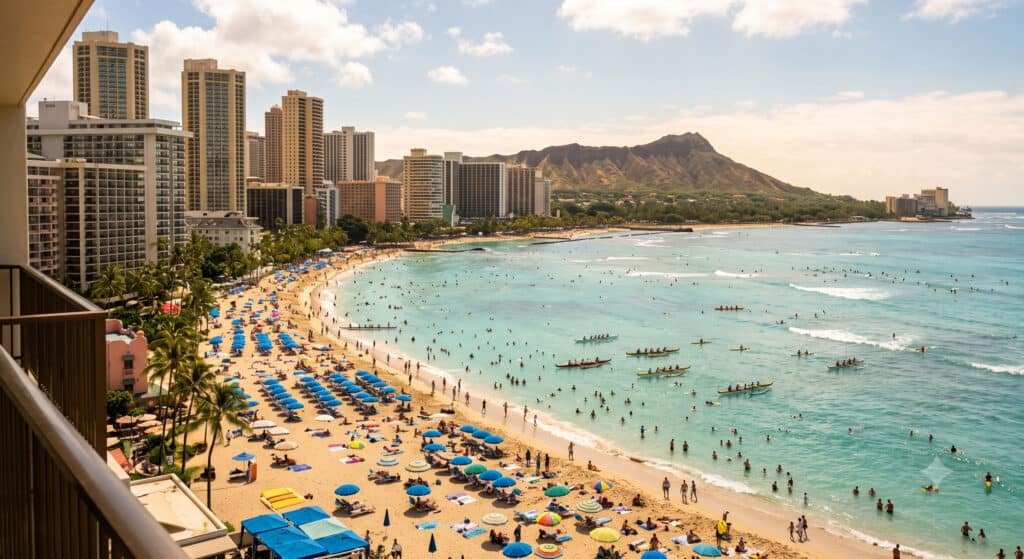
There’s no version of Waikiki that’s a hidden gem. It’s the most visited neighborhood in Hawaii, packed onto a narrow strip of coastline, and during spring break, summer, and the Thanksgiving-to-New-Year’s stretch, it can feel like the entire mainland showed up at once. It basically did.
Waikiki Beach and Kuhio Beach fill in by mid-morning most days in peak season, Kalākaua Avenue gets shoulder-to-shoulder on weekend nights, and restaurant waits of 45 minutes without a reservation aren’t unusual.
The fix is timing, not avoidance. Hit the beach by 7 a.m. and you get a completely different Waikiki — soft light, calm water, hardly anyone around. Walk ten minutes east toward Sans Souci Beach and the crowds thin out fast. Make dinner reservations, or eat at 5 p.m., and build at least two days into your trip that leave Waikiki entirely; the rest of O‘ahu doesn’t have this problem.
5. The Flight and Jet Lag: Hawaii Is Far From Almost Everywhere
From the West Coast, Honolulu runs about 5.5 to 6.5 hours nonstop — Los Angeles typically lands close to 6 hours. From the East Coast, figure 10 hours or more on a direct flight, or a layover and a full travel day. The Midwest splits the difference at 8 to 9 hours depending on routing.
Hawaii also doesn’t observe Daylight Saving Time, so the gap between Hawaii and the mainland shifts by an hour twice a year. East Coast travelers in summer are adjusting to a 6-hour difference; in winter it’s 5 — and that first day can be rough, especially with kids.
Plan a soft landing on day one: beach, pool, casual food, early bedtime, nothing ambitious. Skip the arrival-day rental car if you can, and East Coast travelers should budget two full days to feel fully normal again.
6. It Can Feel Commercialized, Especially on the Main Strip
This is the downside that surprises people most. Waikiki is beautiful and genuinely fun, but it’s also heavily developed in a way that can read as resort zone more than tropical island once you’re off the beach. Luxury Row, the big hotel towers, and the same handful of restaurant chains clustered around Beachwalk and the International Market Place are polished — but it’s not the Hawaii most people picture before they land.
Treat Waikiki as a comfortable home base rather than the whole trip, and the feeling mostly disappears. Build in at least two full days outside the neighborhood — the Windward side and Hale‘iwa feel like a different island entirely. Find one local moment on your trip: a plate lunch counter, a sunrise beach walk, the Kuhio Beach hula show at sunset. Those cost almost nothing and deliver the version of Hawaii that Kalākaua Avenue sometimes buries.
Is Waikiki Still Worth It in 2026?
For most travelers, yes. The beach is genuinely one of the best in the country, the walkability is real, and the logistics are about as simple as international-feeling travel gets. Families, couples, and first-time Hawaii visitors consistently land on “we’re coming back” by the end of the trip.
Going in without illusions is what makes the difference: budget for the real total rather than the advertised rate, expect the crowds and plan around them, and build in time to see O‘ahu beyond the strip. Do those three things and the downsides shrink fast, while the water, the food, and the sunsets more than make up for them.
For help putting it together, our 5-day Waikiki itinerary maps out a balanced mix of beach time, day trips, and local spots that covers the best of the island without burning you out.
Frequently Asked Questions About Waikiki Vacation Downsides
Is Waikiki too touristy?
It depends on your expectations. Waikiki is a purpose-built resort district — the most famous one in Hawaii — and the main strip is very tourist-oriented. But the beach is genuinely beautiful and it’s easy to reach less-touristy parts of O‘ahu on a day trip. Most visitors find the trade-off worth it.
What is the biggest downside of visiting Waikiki?
Cost. Most first-timers don’t budget for Hawaii’s stacked taxes, resort fees, and hotel parking, and the final hotel bill often runs 25% to 40% higher than the advertised nightly rate once those charges are included.
Is Waikiki crowded year-round?
Yes, but some periods are more manageable than others. The worst crowds fall during spring break (mid-March to mid-April), summer (June through August), and the Thanksgiving-to-New-Year’s stretch. Late April through May and September through October offer thinner crowds and better hotel pricing.
How bad is jet lag in Hawaii?
It depends on where you’re traveling from. West Coast visitors usually adjust in a day or two. East Coast travelers face a 5- to 6-hour time difference, since Hawaii doesn’t observe Daylight Saving Time, and it can take two to three days to fully shake.
Is Waikiki good for travelers who want something authentic and off-the-beaten-path?
Not on its own. Waikiki’s core is tourist-oriented by design. For a more authentic slice of O‘ahu, head beyond the strip to Kapahulu Avenue, Kaimuki, Mānoa, the North Shore, or the Windward Coast.
Are there hidden fees at Waikiki hotels?
Yes. Beyond the room rate, most Waikiki hotels charge a resort fee of $45 to $65 per night, self-parking that averages around $44.49 per night, and stacked lodging taxes now totaling roughly 18.5% of the room rate on O‘ahu in 2026. Always ask for the full total before confirming a booking.