
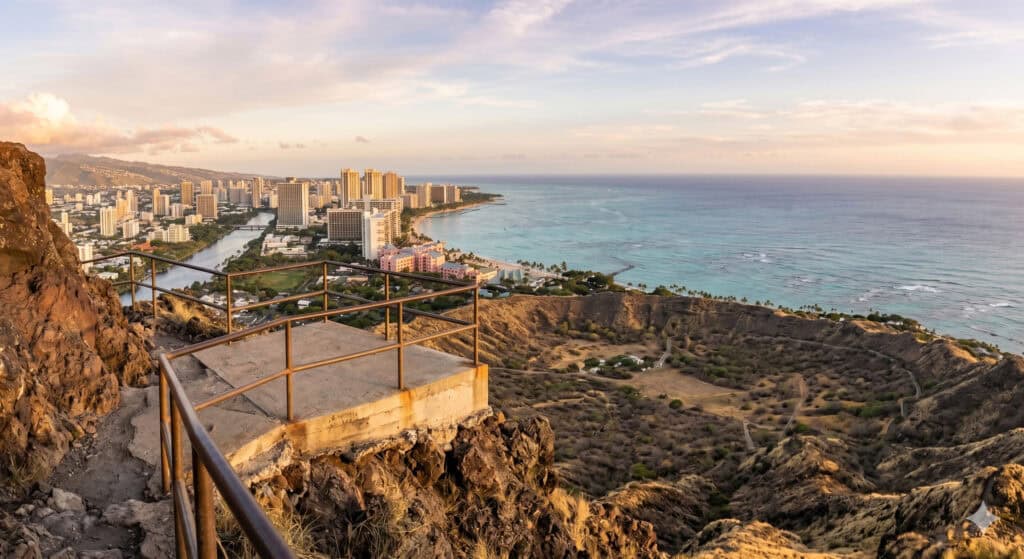
There’s a moment at the Diamond Head summit when it all clicks — Waikīkī’s curve of sand laid out below you, the Pacific stretching to the horizon, and the quiet satisfaction of knowing you earned this view on foot. Diamond Head State Monument (Lēʻahi) is one of the most visited hikes in the entire country, and the payoff is genuinely one of those “okay, I’m really in Hawaiʻi” moments. But this isn’t a hike you can just show up for anymore. Non-residents need reservations, there are fees involved, and the popular time slots sell out — sometimes days in advance. Here’s everything you need to plan your Diamond Head hike right.
What Is Diamond Head — and Why Is It Called That?
Diamond Head is a tuff cone crater formed roughly 300,000 years ago by a single explosive volcanic eruption along Oʻahu’s southeastern coast. It sits just east of Waikīkī and is easily the most recognizable silhouette in all of Hawaiʻi. The military saw its strategic potential early: the bunkers, tunnels, and fire control stations you’ll pass on the trail were built to defend Oʻahu’s coastline starting in the early 1900s — which is why this hike feels like part geology lesson, part military history tour, and part postcard come to life.
The original Hawaiian name is Lēʻahi, often translated as “brow of the tuna,” referencing the crater’s distinctive profile from certain angles at sea. The English name came later, when 19th-century British sailors spotted sparkling crystals in the area and got a little overexcited — the crystals turned out to be calcite, not diamonds. The name stuck anyway. Given the views up top, it still fits.
Current Diamond Head Fees and Hours (2026)
Here’s the practical rundown. Non-residents pay $5 per person to enter and $10 per vehicle to park inside the crater. Hawaii residents with a valid Hawaii driver’s license or state ID get in free. Children 3 and under are also free. The park accepts credit card only — no cash transactions at the gate.
Hours are 6:00 AM to 6:00 PM daily. The last reservation slot is 4:00 PM, which means last entry is 4:30 PM. Gates close at 6:00 PM sharp — rangers enforce it, so don’t cut it close on a late-afternoon visit. The park is closed on Christmas Day and New Year’s Day, so plan around those if your trip overlaps the holidays.
One thing that catches people off guard: if you’re driving, parking inside the crater is booked in two-hour time slots. Walk-in and rideshare visitors book one-hour entry time slots. Either way, you must arrive within the first 30 minutes of your reserved slot or you risk being turned away. Build a buffer into your morning — Waikīkī traffic can be unpredictable and the park won’t hold your spot.
How to Book Your Diamond Head Reservation
All non-resident reservations go through gostateparks.hawaii.gov — Hawaii DLNR’s official booking system. No app needed; it works on any device. Reservations open up to 30 days in advance at midnight Hawaii Standard Time. The early slots — particularly 6:00–7:00 AM — tend to vanish within hours of becoming available. If you know your travel dates, book the moment the 30-day window opens. This is not one to figure out the night before.
The refund policy is reasonable: you can cancel and receive a refund up to three days before your entry date. Change your plans last-minute and you’re likely out the money — another solid reason to choose a date you’re confident about before booking.
If you’re visiting alongside a Hawaii resident, their free entry doesn’t extend to you. Non-resident guests still need their own reservations, regardless of who they’re hiking with. Don’t show up assuming the resident’s exemption covers your group.
Getting to Diamond Head from Waikīkī
Diamond Head is roughly 10 minutes from most Waikīkī hotels, which means you have real choices on how to get there — and the right one depends on your budget and what you’re doing afterward.
TheBus is the budget-friendly option and genuinely easy. Route 23 runs from Waikīkī directly to the monument entrance. It’s a clean choice for solo travelers or anyone who doesn’t want to think about parking. Just give yourself a few extra minutes of buffer — missing your reserved entry window because a bus ran slow is an easily avoidable headache.
Rideshare (Uber or Lyft) is the fastest, lowest-friction option for couples and small groups. Drop-off lands you right at the entrance, you book the walk-in entry slot, and you skip the parking reservation entirely. I prefer this approach — it’s often cheaper than parking and you don’t have to race to clear the crater before your two-hour slot expires.
Driving works well if you’re building a longer day around the southeast coast — pairing Diamond Head with Hanauma Bay or the Makapuʻu Lighthouse trail, for example. Our guide to the best day trips from Waikiki lays out a solid southeast Oʻahu route worth bookmarking. Just keep in mind that crater parking is limited and the two-hour slot moves faster than expected once you’re actually hiking.
The Waikīkī Trolley also swings toward Diamond Head — a laid-back, no-stress option if you’re already using it for other sightseeing around town.
What the Diamond Head Summit Trail Is Actually Like
The trail is 1.6 miles round trip with 560 feet of elevation gain. The difficulty rating is moderate, which is accurate — it’s accessible to most reasonably fit visitors, but it does earn that rating, particularly in the final push to the summit.
On the way up you’ll navigate a mostly paved path that gets rougher as you climb, steady switchbacks with frequent rest spots that double as viewpoints, and then — near the top — a 225-foot tunnel and a serious set of stairs. The stairs are steep. Your calves will notice. The views make them completely irrelevant.
The tunnel surprises some hikers. It’s lighted and manageable for most people, but if tight spaces genuinely bother you, knowing it’s coming helps. Go early in the morning when foot traffic is lighter and the tunnel doesn’t feel like a crowded rush-hour situation. Once you clear it and climb the final stairs, you’re standing at a 360° panorama: Waikīkī’s coastline, Koko Head in the distance, the Honolulu skyline, and open Pacific in every direction. Budget extra time at the top — the photos take a while when the view is this good.
Most visitors finish the round trip in 1.5 to 2 hours. If your group stops often for photos and water breaks (you will), budget 2 to 2.5 hours to be comfortable. If you’re working Diamond Head into a bigger Waikiki week, our 5-day Waikiki itinerary fits it neatly into Day 2 as part of a morning-activity-plus-afternoon-beach combination that works well.
Best Time to Go and What to Bring
The answer is almost always early morning. The 6:00–7:00 AM window gives you cooler temperatures, thinner crowds on the stairs and tunnel, and softer light for photos. You finish before mid-morning, which leaves the full day ahead — more beach time, less heat exhaustion. I’ve done this hike at 10 AM and it’s fine. I’ve done it at 7 AM and it’s noticeably better in every way.
Midday is the hottest and most crowded window — not unmanageable, just harder. Late afternoon has attractive light, but only works if you’re confident your group can complete the hike comfortably before that 4:00 PM last reservation cutoff.
What to bring is simple: water (bring more than you think you need — there is almost no shade on this trail), shoes with real grip (not flip-flops, not sandals — the stairs and uneven tuff near the summit make proper footwear important), a hat, sunglasses, and reef-safe sunscreen applied before you leave the hotel. A light snack at the summit is a nice touch; everything tastes better at 560 feet with a view like that. Our full Waikiki packing guide covers the broader Hawaii trip list, but for Diamond Head specifically, water and shoes are the non-negotiables.
Hiking Diamond Head with Kids (and Accessibility Notes)
Diamond Head is a popular family hike for a reason — kids who can walk independently handle it well with breaks, water, and a patient pace. Go early for cooler temperatures and lighter crowds on the stairs. Plan extra water and snacks for the little ones. Keep them close near the steep stair sections near the summit, where the footing gets more interesting. On the way back down, shave ice in Waikīkī is a time-honored reward for the whole group.
A couple of logistics worth knowing before you go: strollers are not suitable for the summit trail. If you’re hiking with a toddler, a comfortable carrier is the practical solution. Also note that children 3 and under are free — you won’t need to purchase an entry ticket for the very small ones.
On accessibility: the crater floor facilities are much more accessible than the summit route. The summit trail itself — steep stairs, uneven tuff, and tight sections — is not ADA-accessible. If full mobility is a consideration, the lower crater area still offers history exhibits and views of the crater interior worth seeing.
Diamond Head regularly tops the list of best things to do in Waikiki for first-timers — and it genuinely deserves that spot. If you’re planning a full activity lineup, a Waikiki luau makes an excellent evening follow-up to a morning summit hike.
Frequently Asked Questions About the Diamond Head Hike
Do I need a reservation to hike Diamond Head?
Yes, if you’re a non-Hawaii resident. All non-residents must book a timed entry slot through gostateparks.hawaii.gov before arriving. Walk-up entry without a reservation is extremely limited and often unavailable. Book early — morning slots sell out quickly, especially during peak travel seasons.
How much does Diamond Head cost to hike in 2026?
Non-residents pay $5 per person for entry and $10 per vehicle to park inside the crater. Hawaii residents enter free with a valid Hawaii ID or driver’s license. Children 3 and under are free. The park accepts credit card only — no cash. Commercial vehicle fees are higher and vary by passenger count.
How far in advance can I book Diamond Head reservations?
Reservations open 30 days in advance at midnight Hawaii Standard Time at gostateparks.hawaii.gov. Early morning slots (6:00–7:00 AM) often sell out within hours of opening. Book as early as possible if you have a specific date in mind. Refunds are available up to three days before your entry date.
Is Diamond Head hard to hike?
It’s rated moderate and that’s accurate. The trail is 1.6 miles round trip with 560 feet of elevation gain. Most of the difficulty is concentrated near the summit: a 225-foot tunnel followed by steep stairs. Most visitors complete the round trip in 1.5 to 2 hours. Wear real shoes with grip, bring more water than you think you need, and go early if possible — the trail is more comfortable before midday heat sets in.
What is the best time of day to hike Diamond Head?
Early morning — ideally starting at 6:00 or 7:00 AM. Temperatures are cooler, crowds are thinner on the stairs and tunnel, and the light is genuinely good for photos. Midday is the hottest and most crowded. Late afternoon has nice light but don’t cut it close — the last reservation slot is 4:00 PM and gates close at 6:00 PM.
Is Diamond Head worth it if I only have a few days in Waikiki?
Absolutely. It’s one of the best time-to-payoff ratios of anything you can do near Waikīkī — two hours of your morning in exchange for one of the most iconic views in all of Hawaiʻi. Even on a short trip, it belongs on the list. Book your reservation the same time you book your hotel and it’s a done deal.
Once you’re back at the bottom, Waikīkī is 10 minutes away — perfect for a beach cooldown, cold drink, and the rest of whatever your day has in store. If you haven’t mapped out your full trip yet, our best Oʻahu day trips from Waikiki has a great southeast coast loop that pairs Diamond Head with Hanauma Bay for an easy adventure day.